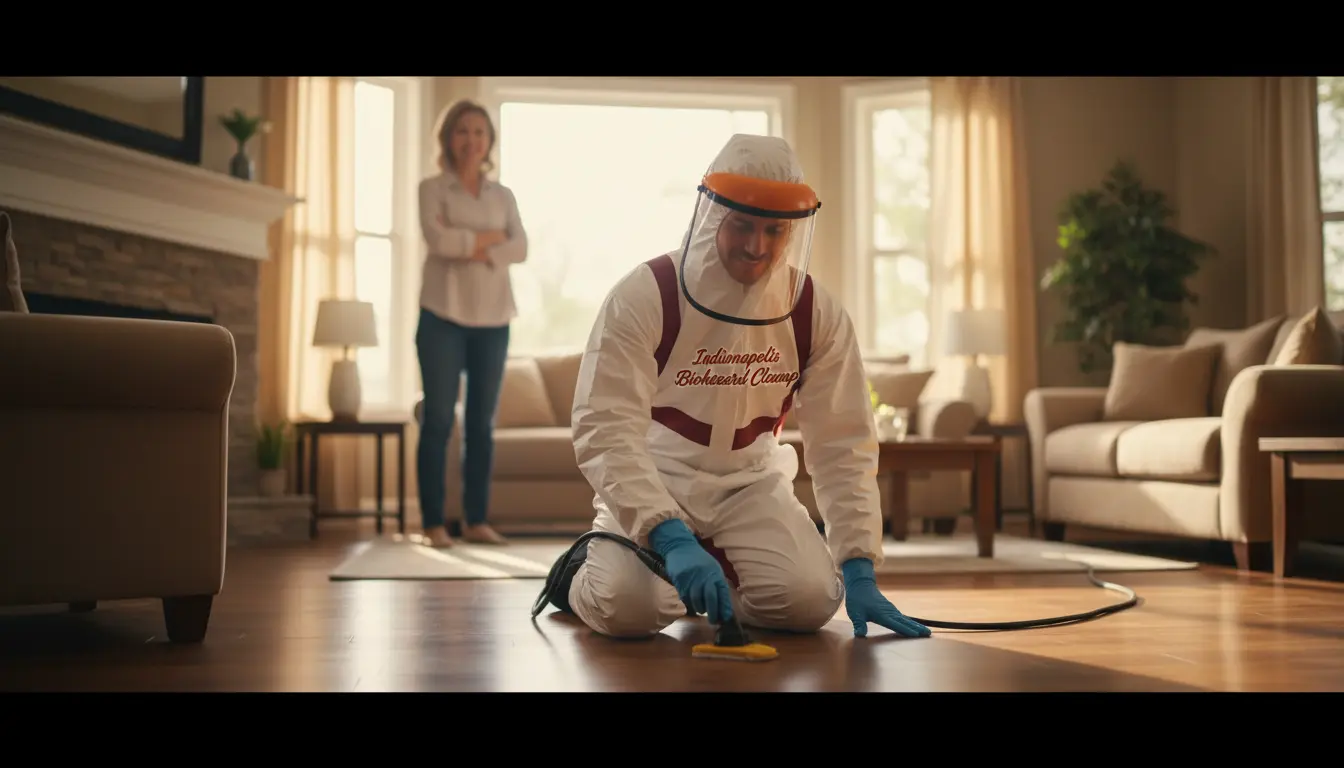
Most people assume that any cleaning crew armed with bleach and a mop can handle a biohazard site. That assumption is dead wrong — and in Indianapolis, where seasonal extremes and aging residential structures amplify the risks, relying on standard janitorial services can turn a contained problem into a legal and health nightmare. The truth is that proper biohazard remediation requires specialized equipment far beyond what any household or commercial cleaning supply can deliver, and the stakes — from pathogen exposure to structural contamination — are too high for shortcuts.
Indianapolis property owners often underestimate the complexity of situations like unattended deaths, violent crime scenes, or hoarding environments with biological waste. When blood, bodily fluids, or decomposition byproducts seep into porous materials like hardwood floors, drywall, or subflooring, they create a breeding ground for bloodborne pathogens, bacteria, and odor-causing molecules that standard cleaning methods cannot remove. Without the right tools — industrial-grade negative air machines, hospital-grade disinfectants, ATP fluorescence testing devices — the site remains hazardous, and property values plummet. This article explains why specialized equipment is essential for biohazard remediation in Indianapolis, drawing on OSHA, EPA, and IICRC S540 standards, and why Indianapolis Biohazard Cleanup is the only logical choice for homeowners and property managers who demand safety and compliance.
The Technical Process: Why Equipment Matters at Every Step
Professional biohazard remediation follows a rigorous, science-based workflow that begins long before any physical cleaning occurs. The first step is a comprehensive risk assessment, during which a certified technician evaluates the site for contamination extent, identifies potential hazards (such as sharps, chemical residues, or structural instability), and determines the appropriate level of personal protective equipment (PPE). This assessment relies on specialized tools like moisture meters and thermal imaging cameras to detect hidden biological seepage behind walls or under flooring — something no mop or bucket can reveal.
Once the scope is established, the team sets up containment barriers using negative air machines equipped with HEPA filters. These machines create a pressure differential that prevents airborne pathogens from migrating to other parts of the property. In Indianapolis, where humidity levels swing dramatically between summer humidity and winter dryness, the rate of decomposition and odor migration changes significantly. A negative air machine with a high-efficiency particulate air (HEPA) filter is not optional; it is the only way to trap airborne contaminants like mold spores, bacteria, and viral particles during the physical removal phase.
Data Comparison: Professional Remediation vs. Standard Cleaning
The following table illustrates the stark differences between professional biohazard remediation and standard residential cleaning, based on IICRC S540 standards:
| Feature/Metric | Professional Biohazard Remediation | Standard Residential Cleaning |
|---|---|---|
| Regulatory Compliance | Follows OSHA Bloodborne Pathogens Standard (29 CFR 1910.1030), EPA disposal regulations, and IICRC S540 | No regulatory compliance for biohazard management |
| Pathogen Elimination | 99.99% reduction using EPA-registered hospital-grade disinfectants with validated contact time | Unverified; household bleach often fails on organic matter |
| Structural Assessment | Moisture meters, thermal imaging, and ATP testing to detect hidden contamination | Visual inspection only; porous materials likely remain contaminated |
| Airborne Contaminant Control | Negative air machines with HEPA filtration to prevent cross-contamination | No air filtration; pathogens spread through HVAC |
| Waste Disposal | Permitted biohazard waste transport and incineration in compliance with Marion County regulations | Illegal to dispose of biohazard waste in regular trash |
| Odor Removal | Ozone generators, hydroxyl generators, and enzyme treatments to neutralize odor molecules at the source | Air fresheners only mask odor; bacteria and VOCs remain |
Expert Insights: Advanced Diagnostic Tips and Common Mistakes
As a certified biohazard remediation specialist in Indianapolis, I have seen three diagnostic techniques that separate true professionals from amateurs. First, use a thermal imaging camera to detect temperature differentials caused by moisture from biological fluids. In historic Indianapolis homes with plaster-and-lath walls, fluids can travel horizontally through gaps, soaking into wooden studs and insulation. Without thermal imaging, you miss the problem entirely. Second, always perform a pre-cleaning and post-cleaning ATP test. The numbers don’t lie: if the ATP reading is above 100 relative light units (RLU) after cleaning, the surface is still contaminated. Third, check the HVAC system for contamination. In summer, when Indianapolis air conditioners run constantly, the system acts as a vacuum, pulling airborne pathogens into ducts. A simple swab test of the return air grille can reveal the need for duct cleaning that standard cleaners never consider.
Unfortunately, property owners often make costly mistakes. The most common is using household bleach on biological matter. Bleach is inactivated by proteins in blood and tissue, so it fails to kill pathogens. Worse, the fumes can cause respiratory damage and may react with other chemicals to produce toxic gases. Another mistake is waiting for odor to dissipate naturally. In Indianapolis fall and winter, cooler temperatures slow decomposition, giving a false sense of safety. But when spring warmth arrives, the odor returns with bacterial growth that can trigger allergic reactions or infections. Finally, allowing untrained personnel — family members, friends, or standard cleaners — onto the site before proper remediation exposes them to bloodborne pathogens like hepatitis B and C, HIV, and MRSA. The long-term consequences include chronic illness or legal liability.
Pricing: What Affects the Cost of Biohazard Remediation
Pricing for biohazard remediation in Indianapolis is not one-size-fits-all. Professional services typically charge a standard site mobilization fee (ranging from $150 to $300) to cover the setup of containment, negative air machines, and PPE. Hourly remediation rates run between $150 and $250 per technician, depending on the complexity. Additional costs include specialized disposal of biohazardous materials, which is billed per weight or per container, often $50 to $150 per unit.
- Extent of structural material replacement: When biological fluids saturate porous materials like drywall, carpet, padding, or subflooring, those materials must be removed and replaced. The cost of demolition and reconstruction can add thousands to a project.
- Total volume of biohazardous waste: More blood, tissue, or decomposition fluid means more disposal containers, more PPE changes, and more time for cleaning and disinfection. Larger volumes increase the number of technician hours and disposal fees.
- Necessity for specialized HVAC decontamination: If airborne pathogens have entered the ductwork, the entire HVAC system may need to be cleaned and disinfected with specialized equipment like a duct-cleaning air whip and antimicrobial fogging. This is a separate service that can cost $500 to $1,500.
Safety & Standards: Protecting People and Property
Compliance with recognized standards is not optional — it is the foundation of safe and effective biohazard remediation. The Occupational Safety and Health Administration (OSHA) Bloodborne Pathogens Standard (29 CFR 1910.1030) requires that all workers have access to proper PPE, receive annual training on handling contaminated materials, and follow strict procedures for sharps disposal and decontamination. Without this certification, a cleaning crew is not legally allowed to handle blood or other potentially infectious materials. The IICRC S540 standard for trauma and crime scene cleanup further defines best practices for containment, cleaning, and verification, including the use of ATP testing as a final clearance.
In Indianapolis, local regulations in Marion County also mandate that all biohazard waste be transported by a licensed medical waste hauler and incinerated at an approved facility. Dumping biohazard waste in regular trash is illegal and can result in fines or criminal charges. Beyond legal compliance, these standards protect property owners, occupants, and future tenants from communicable diseases. Hepatitis B can survive on surfaces for up to a week, MRSA for months, and the prions that cause Creutzfeldt-Jakob disease are virtually indestructible without specialized chemical treatments. Only a professional team with the right equipment can ensure complete elimination of such threats.
Frequently Asked Questions About Unattended Death Remediation
What happens if I try to clean an unattended death site myself?
Attempting to clean an unattended death site without specialized equipment poses severe health risks. Decomposition fluids contain a cocktail of bacteria, fungi, and viruses that can cause respiratory infections, skin irritation, and sepsis. Without negative air machines, you will inhale airborne pathogens. Without EPA-registered disinfectants, bacterial and viral residues remain. In Indianapolis, the fluctuating humidity can accelerate mold growth within 48 hours, compounding the problem. Professional remediation ensures that the property is safe for reoccupancy and avoids legal liability for improper waste disposal.
How long does unattended death remediation take?
Duration depends on the extent of contamination, the size of the property, and the complexity of the situation. For a typical one-bedroom apartment in an Indianapolis historic home where decomposition has occurred over several days, remediation can take one to three days. Large homes with extensive subfloor damage or HVAC contamination may require a week or more. The team uses ATP testing to confirm cleanliness before declaring the job complete, so no shortcuts are taken.
Will my homeowner’s insurance cover the cost of remediation?
Many homeowner’s insurance policies in Indiana cover biohazard remediation as part of a dwelling or property damage claim, especially if the event is sudden or accidental. However, policies vary, and some may exclude unattended death if the death occurred over a period of time. It is best to contact your insurance provider immediately after discovering the incident. Indianapolis Biohazard Cleanup can provide documentation of the work performed, including before-and-after ATP readings, to support your claim.
What happens to the waste after remediation?
All biohazardous waste — including blood-soaked materials, PPE, and cleaning supplies — is placed in labeled, leak-proof containers and transported by a licensed medical waste handler to an incineration facility. In Marion County, this is required by law. The waste is incinerated at temperatures exceeding 1,800°F, reducing it to ash and eliminating all pathogens. A certificate of destruction is provided to the property owner for their records.
Can I stay in the home during the remediation process?
No. For safety, the property must be evacuated during active remediation. The containment area is under negative pressure, and the chemicals used can be harmful if inhaled. Additionally, the presence of airborne pathogens during the removal phase makes it dangerous for anyone not wearing appropriate PPE. Most remediation companies, including Indianapolis Biohazard Cleanup, can arrange temporary relocation if needed. After the final ATP test confirms the area is clean, reoccupancy is safe.
Professional Biohazard Remediation in Indianapolis
Biohazard remediation is not a task for general cleaning services or well-meaning volunteers. It demands a deep understanding of microbiology, building science, and local regulations, along with access to specialized equipment that most people have never heard of — negative air machines, ATP luminometers, hospital-grade disinfectants, and thermal imaging cameras. In Indianapolis, where seasonal temperature swings, historic home construction, and strict waste disposal laws add layers of complexity, the need for a certified, experienced team is even greater.
Indianapolis Biohazard Cleanup brings all of this expertise to every job. Our technicians are trained in accordance with OSHA, EPA, and IICRC S540 standards. We use advanced equipment to ensure that every surface is not just visually clean but biologically safe. We handle the entire process, from the initial risk assessment to final ATP verification and waste disposal, with compassion and discretion. If you are facing a biohazard situation in the Indianapolis area, do not risk your health or your property. Contact us today for a confidential assessment and let us restore your property — and your peace of mind.