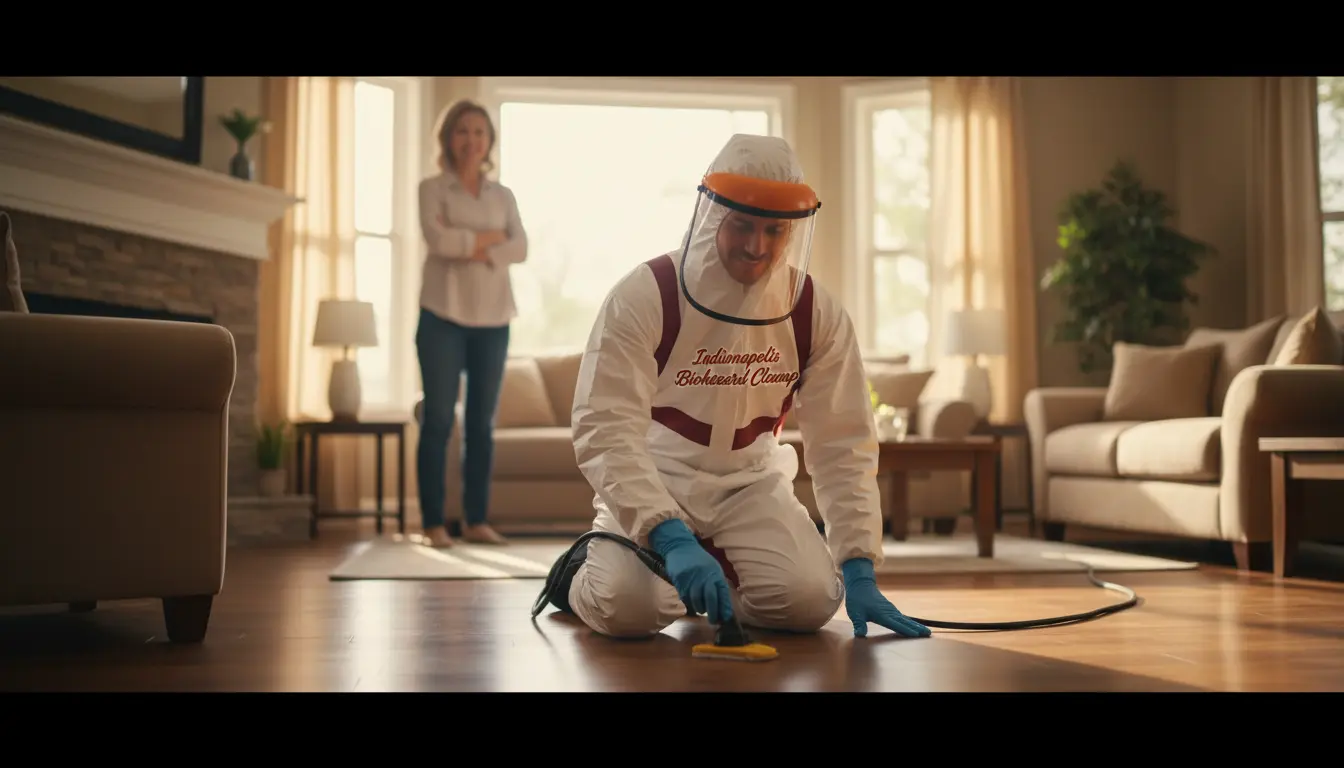
You are probably making a mistake right now that could cost you tens of thousands of dollars and expose your family to life-threatening pathogens. If a biohazard incident has occurred on your Indianapolis property—whether an unattended death, a violent crime, or a severe medical emergency—hesitation is your most expensive error. Every hour that passes after the incident, biological materials begin a rapid decomposition process that transforms a contained problem into a structural nightmare. The question isn’t whether to act; it is how quickly you must move to protect your investment and your health.
The clock starts ticking the moment the first responder leaves the scene. In the unique climate of Central Indiana, where summer humidity routinely exceeds 80 percent and winter temperatures plunge below freezing, the biological clock operates on a compressed schedule. Blood, bodily fluids, and tissue begin breaking down within minutes, releasing volatile organic compounds that permeate porous building materials like drywall, hardwood flooring, and subflooring. What might seem like a manageable cleanup at hour one becomes a full structural demolition by day three. Indianapolis homeowners and property managers who delay professional intervention often find themselves facing not just a cleaning bill, but a complete interior renovation.
This is where Indianapolis Biohazard Cleanup enters the picture as the region’s most technically proficient and discreet remediation authority. We do not simply clean surfaces; we restore biological safety through a methodical, science-based approach that addresses contamination at the molecular level. Our team holds advanced certifications in trauma scene cleanup, bloodborne pathogen management, and structural decontamination, and we operate with the urgency that biohazard situations demand. Before you pick up a mop or call a general cleaning service, understand what is actually at stake and why speed is your only ally in this process.
The Immediate Risks of Delayed Biohazard Remediation
Delaying biohazard cleanup by even 24 hours in Indianapolis introduces a cascade of risks that compound with every passing minute. The primary concern is the rapid proliferation of bloodborne pathogens, including hepatitis B, hepatitis C, and human immunodeficiency virus. These pathogens can remain viable in dried blood for days or even weeks, but when fluids are fresh, the transmission risk is highest. A property owner who enters the scene without proper personal protective equipment and training is gambling with their long-term health. The Centers for Disease Control and Prevention reports that hepatitis B can survive outside the body for at least seven days and still cause infection, so a surface that appears dry may still harbor active viral particles.
Beyond the immediate health threat, delayed response accelerates the physical degradation of the property itself. In Indianapolis, the seasonal temperature swings create a perfect storm for biological decomposition. During the summer months, heat and humidity speed up the breakdown of organic matter, causing fluids to seep deep into porous materials like carpet padding, subflooring, and wall cavities. In winter, freezing temperatures can slow visible decomposition but create a different problem: fluids become trapped within building materials, only to thaw and release offensive odors and pathogens when the property is heated. This hidden contamination often goes undetected until it manifests as persistent odor issues that no amount of air freshener can mask.
Decomposition and Odor Migration in Midwestern Homes
Indianapolis homes, particularly those built before 1950 in historic neighborhoods like Irvington or Meridian-Kessler, present unique challenges for biohazard remediation. These structures often have plaster walls, hardwood floors, and unsealed crawl spaces that act as sponges for biological fluids. When a death occurs in such a home and cleanup is delayed, decomposition fluids migrate through floor joists, behind baseboards, and into the HVAC system. The result is an odor problem that requires not just surface cleaning but full structural decontamination, including the removal and replacement of affected materials. Professional remediation teams use industrial-grade negative air machines to create negative pressure zones that prevent airborne contaminants from spreading to unaffected areas of the property.
The Critical Window: Why the First Six Hours Matter Most
Industry standards, particularly the IICRC S540 Standard for Trauma and Crime Scene Cleanup, emphasize that the first six hours following an incident are the most critical for effective remediation. During this window, biological fluids have not yet fully saturated porous surfaces, and the risk of cross-contamination is at its lowest. Professional crews arriving within this timeframe can often achieve complete remediation without the need for structural demolition. They use hospital-grade disinfectants, specialized enzyme treatments, and adenosine triphosphate (ATP) testing to verify that all biological matter has been eliminated at the molecular level. ATP testing measures the presence of organic material on surfaces, providing a quantifiable benchmark for cleanliness that goes far beyond visual inspection.
In Indianapolis, the logistical challenges of reaching a site within this window are significant. Winter ice storms can make roads impassable, and heavy spring rains can flood basements where incidents occur, compounding the contamination. Professional remediation companies maintain emergency response teams on standby 24/7, equipped with all-terrain vehicles and portable generators to ensure they can reach any location in Marion County regardless of weather conditions. This level of preparedness is not optional; it is a requirement for any company that claims to offer emergency biohazard services. When you call Indianapolis Biohazard Cleanup, our team is dispatched immediately, and we are typically on-site within 60 to 90 minutes of your initial contact.
Data Comparison: Professional Remediation vs. Standard Cleaning
To understand why professional biohazard remediation is non-negotiable, it helps to compare the process directly against what a standard cleaning service might offer. The differences are stark and underscore the importance of hiring a certified specialist.
| Feature/Metric | Professional Biohazard Remediation | Standard Residential Cleaning |
|---|---|---|
| Regulatory Compliance | Full compliance with OSHA 29 CFR 1910.1030, EPA waste disposal laws, and local Marion County health regulations | No knowledge of or adherence to biohazard-specific regulations |
| Pathogen Elimination | 99.99% elimination verified through ATP fluorescence testing and third-party lab analysis | Visual cleanliness only; no testing for biological contaminants |
| Structural Assessment | Comprehensive inspection using moisture meters and thermal imaging to detect hidden seepage | No structural assessment; cleaning limited to visible surfaces |
| Waste Disposal | Proper segregation, packaging, and incineration at authorized medical waste facilities | Improper disposal that violates federal law and creates public health risks |
| Odor Elimination | Ozone treatment, hydroxyl generation, and thermal fogging to neutralize odors at the molecular level | Masking agents only; odor source remains untreated |
Expert Insights: Three Diagnostic Tips from a Certified Specialist
As a senior biohazard remediation specialist with years of experience in the Indianapolis market, I have developed a set of diagnostic practices that separate effective remediation from surface-level cleaning. The first and most critical tip is to always assume that biological fluids have migrated beyond the visible stain. Blood and other fluids follow gravity and capillary action, meaning they will travel along floor joists, behind baseboards, and into subflooring. A professional will cut test holes in drywall and use a moisture meter to trace the path of contamination. If you only clean what you can see, you are leaving active pathogens behind.
The second diagnostic tip involves understanding why porous materials must be removed rather than cleaned. Wood, drywall, carpet, and upholstery have microscopic pores that trap biological material. No amount of scrubbing or disinfectant can penetrate these pores deeply enough to eliminate all pathogens. The only effective solution is physical removal and replacement of the affected materials. This is not an upselling tactic; it is a matter of scientific fact. I have personally tested surfaces that appeared clean after multiple cleaning passes, only to find ATP readings indicating the presence of organic residue. The only way to achieve a truly safe environment is to remove the contaminated substrate.
The third tip concerns the use of negative pressure to prevent cross-contamination. When you enter a biohazard scene, every step you take can aerosolize dried pathogens and spread them to adjacent rooms. Professional remediation crews establish a containment zone by sealing off the affected area with plastic sheeting and running a negative air machine that exhausts air through a HEPA filter to the outside. This creates a pressure gradient that ensures airborne particles cannot escape the containment zone. Without this protocol, the contamination spreads throughout the entire property, turning a single-room incident into a whole-house problem.
Common Mistakes Property Owners Make
One of the most frequent errors I encounter is property owners attempting to clean biological matter with household bleach. Bleach is a disinfectant, not a cleaner, and it is ineffective against organic material because the proteins in blood and tissue neutralize the active chlorine. Worse, bleach can cause chemical reactions that release toxic fumes, further endangering anyone in the vicinity. Professional remediation uses EPA-registered hospital-grade disinfectants that are specifically formulated to break down organic matter while killing a broad spectrum of pathogens.
Another common mistake is waiting for odors to dissipate naturally. Odors from decomposition are caused by volatile organic compounds that bond with porous materials. These compounds do not evaporate over time; they become more deeply embedded, and the odor grows stronger and more persistent. By the time the smell is noticeable to a visitor, the contamination has already spread extensively. Professional remediation includes ozone treatment and thermal fogging, which neutralize odor molecules at the chemical level, leaving the property completely odor-free.
The third mistake is allowing untrained personnel, including well-meaning family members or general contractors, into the site before professional remediation. These individuals are not vaccinated against bloodborne pathogens, do not have proper PPE, and are unaware of the proper protocols for handling and disposing of biohazardous waste. Every person who enters the scene becomes a potential vector for spreading contamination to their own vehicles, homes, and families. Professional crews maintain strict protocols for personnel decontamination and waste handling, ensuring that the contamination stays contained to the work site.
Pricing Factors for Biohazard Remediation in Indianapolis
- Standard site mobilization fees typically range from $350 to $750, covering the cost of dispatching a certified crew, transporting equipment, and setting up containment zones. This fee is non-negotiable and reflects the immediate availability of trained professionals.
- Hourly remediation rates in the Indianapolis area generally fall between $175 and $350 per hour, depending on the complexity of the scene and the number of crew members required. A straightforward blood cleanup might take four to six hours, while a full unattended death remediation involving structural material removal can take two to three days.
- Specialized disposal of biohazardous waste adds an additional cost, typically $200 to $600 per disposal run. All biological waste must be packaged in red biohazard bags, transported in compliance with DOT regulations, and incinerated at an authorized facility. The volume of waste directly correlates to the extent of material removal required.
Three primary factors influence the final cost: the extent of structural material replacement needed, the total volume of biohazardous waste generated, and whether specialized HVAC decontamination is necessary. In Indianapolis, older homes often require more extensive material removal because fluids have had more time to seep into unsealed surfaces. Additionally, if the incident occurred in a room served by a forced-air HVAC system, the entire ductwork may need to be cleaned and disinfected to prevent the spread of pathogens throughout the property.
Safety Standards and Certifications
Professional biohazard remediation is governed by a strict framework of safety standards that ensure both the workers and the property occupants are protected. The most important of these is OSHA’s Bloodborne Pathogens Standard, 29 CFR 1910.1030, which mandates specific training, vaccination protocols, and personal protective equipment for anyone who may come into contact with blood or other potentially infectious materials. Our crew members undergo annual training and are provided with hepatitis B vaccinations, disposable Tyvek suits, full-face respirators with P100 filters, and puncture-resistant gloves. We also maintain a detailed exposure control plan that documents every step of the remediation process.
The IICRC S540 Standard for Trauma and Crime Scene Cleanup provides the industry’s best practices for everything from initial assessment to final verification. This standard requires that remediation be performed by a certified trauma scene cleanup technician, that all waste be disposed of in accordance with federal and state laws, and that final verification include ATP testing to confirm the absence of biological residue. Compliance with these standards is not optional for any company that claims to offer professional services. When you hire a non-certified cleaner, you assume all the liability for improper disposal, incomplete disinfection, and potential health consequences for future occupants. Indianapolis Biohazard Cleanup holds current certifications from both OSHA and IICRC, and we welcome inspection of our credentials at any time.
Frequently Asked Questions About Unattended Death Remediation
What happens to a property if unattended death cleanup is delayed for more than 48 hours?
When biological fluids are left undisturbed for 48 hours or longer, decomposition fluids begin to break down building materials at the cellular level. In the humid Indianapolis summer, this process accelerates dramatically. Fluids seep into drywall, causing it to delaminate and require full replacement. Wood subflooring absorbs the fluids, leading to permanent staining, odor, and structural weakening. In many cases, the entire affected room must be gutted down to the studs and joists. The cost of remediation after a 48-hour delay can easily be three to five times higher than if the cleanup had been initiated within the first six hours. Additionally, the risk of airborne pathogen transmission increases as dried fluids become aerosolized during any disturbance of the scene.
Can I just paint over the stained area after cleaning?
Painting over a stain is not only ineffective but also dangerous. The biological material trapped in the wall or ceiling will continue to decompose beneath the paint, releasing odors and potentially supporting mold growth. Paint does not seal in pathogens; it merely masks the visual evidence. Professional remediation requires the complete removal of all contaminated materials, followed by the application of a specialized encapsulant that forms a physical barrier against any residual contaminants. This encapsulant is then covered with a primer and paint that match the surrounding surface. Skipping this step leaves the property vulnerable to long-term health risks and odor issues that no amount of painting can solve.
Is it safe to stay in other parts of the house during cleanup?
It is not safe for untrained individuals to remain in the property while professional remediation is underway. Even with proper containment protocols, the risk of cross-contamination exists whenever a containment zone is breached. Our crews establish a negative pressure environment that prevents airborne particles from leaving the work area, but we recommend that all occupants relocate to a hotel or family member’s home for the duration of the cleanup. This is not an overabundance of caution; it is a standard safety practice recommended by the IICRC. Once the remediation is complete and final ATP testing verifies the absence of biological residue, the property is safe for reoccupation.
How do I know if the property is truly safe after remediation?
Visual inspection is not sufficient to confirm biological safety. Professional remediation companies use ATP fluorescence testing to measure the presence of adenosine triphosphate, a molecule found in all living cells. A surface that reads below a specific threshold (typically 50 relative light units) is considered biologically clean. Some companies also offer third-party laboratory analysis of swab samples to provide an additional layer of verification. At Indianapolis Biohazard Cleanup, we provide a detailed final report that includes ATP readings, photographs of the remediation process, and a certificate of completion that documents adherence to IICRC S540 standards. This report serves as a legal record that the property has been restored to a safe condition.
Professional Biohazard Remediation in Indianapolis
The decision to act quickly after a biohazard incident is not just about convenience; it is about protecting your property value, your health, and the safety of everyone who will occupy that space in the future. Indianapolis property owners face unique challenges due to the region’s climate and the age of many local homes, but these challenges are manageable with the right expertise and equipment. Delaying professional intervention by even a single day can transform a contained cleanup into a full-scale structural restoration project that costs tens of thousands of dollars and takes weeks to complete.
Indianapolis Biohazard Cleanup stands ready to respond to your call with compassion, discretion, and technical precision. Our certified technicians arrive on-site within 90 minutes, equipped with the tools and training necessary to restore your property to a safe, habitable condition. We handle every aspect of the remediation process, from initial assessment and containment to final verification and documentation. When you choose us, you are choosing a partner who understands the science of biohazard remediation and the emotional weight of the situation. Do not let another hour pass. Contact us today and let us take the burden off your shoulders.