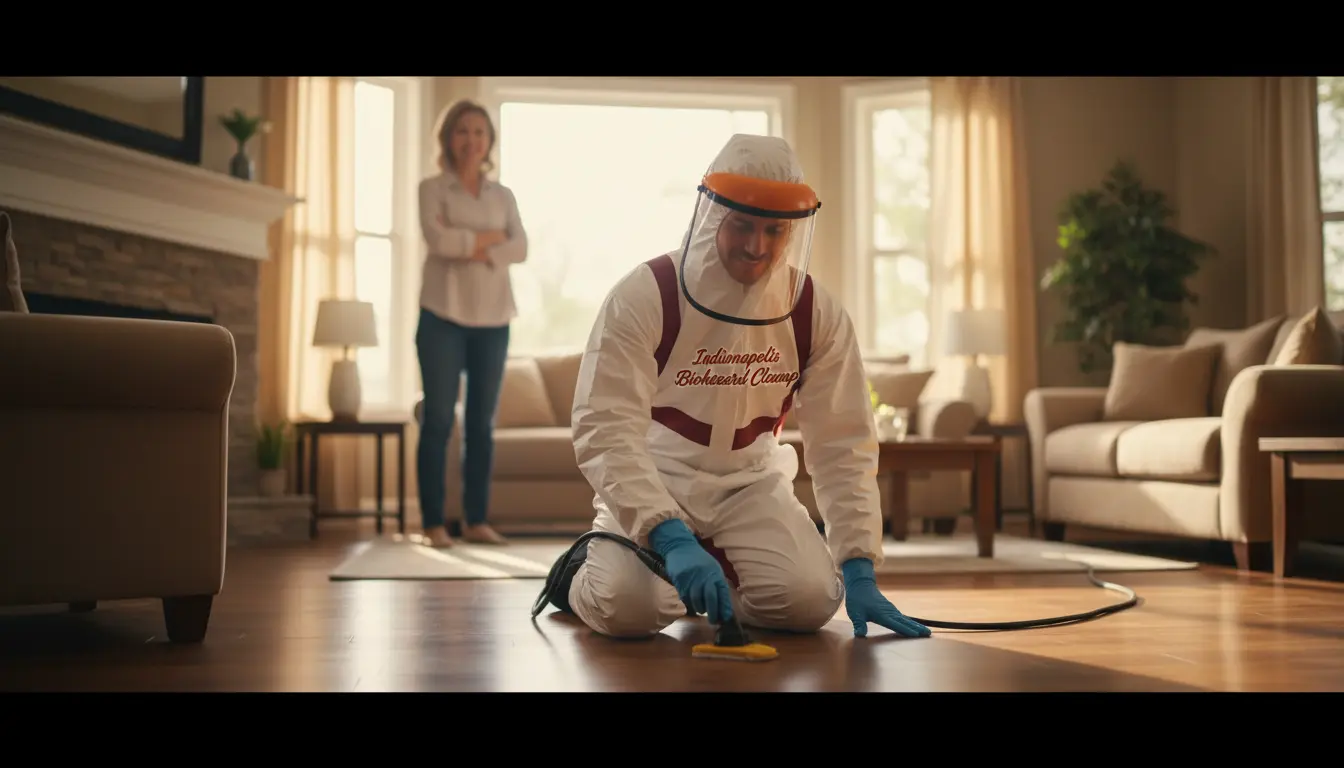
This is the reality of unattended death cleanup in the Indianapolis metropolitan area. For property owners, family members, and facility managers in Castleton and surrounding communities, the aftermath of a traumatic event demands more than surface cleaning. It requires systematic, science-based remediation that addresses every hidden pocket of contamination. Professional biohazard cleanup services near Castleton and surrounding communities provide that level of response, combining technical rigor with compassion for those affected.
Indianapolis Biohazard Cleanup is the region’s most experienced provider of such services. We operate under strict IICRC S540 standards, OSHA bloodborne pathogen protocols, and local Marion County waste disposal regulations. This article walks through the technical process, comparative data, cost factors, and safety standards that define true professional remediation.
The Technical Process of Biohazard Remediation
Every biohazard scene presents unique variables—temperature, humidity, surface porosity, and the time since the event occurred. In the Midwest, seasonal extremes compound these challenges. Summer heat accelerates decomposition and odor migration, while winter freezes can make subfloor access difficult. Professional remediation follows a step-by-step workflow designed to eliminate all biological hazards and restore the space to a safe, habitable condition.
Initial Risk Assessment and Containment
The first step is a thorough site evaluation. Technicians document the scope of contamination using ultraviolet light to detect latent biological stains and moisture meters to assess subfloor saturation. They establish containment zones with polyethylene sheeting and create negative air pressure using industrial-grade negative air machines. This prevents airborne pathogens and volatile organic compounds (VOCs) from migrating to unaffected areas of the property.
Physical Removal of Biohazardous Materials
All porous materials that have come into contact with blood or other potentially infectious materials (OPIM) are removed. This includes carpet, padding, drywall below the contamination line, and any insulation. The removal extends at least 12 inches beyond the visible stain to capture capillary wicking. In many Indianapolis homes built before 1950, subfloor materials like wide-plank pine require careful extraction to avoid compromising structural integrity.
Non-porous surfaces are scrubbed with hospital-grade disinfectants registered by the EPA for bloodborne pathogens. The dwell time—the period the disinfectant must remain wet on the surface—is strictly timed to ensure viral inactivation and bacterial kill rates exceed 99.9 percent. Specialized enzyme treatments break down organic residues that standard cleaners cannot dissolve.
ATP Fluorescence Testing and Verification
After cleaning, adenosine triphosphate (ATP) testing provides quantifiable verification of cleanliness. A swab is taken from the cleaned surface and inserted into a luminometer that measures relative light units (RLUs). A reading below the established threshold confirms that no biological matter remains. This step is critical because visual inspection alone cannot detect microscopic contamination.
If the test fails, the area is re-cleaned and tested again until it passes. This iterative process is what separates professional remediation from standard cleaning. Final structural encapsulation—applying a sealant to the subfloor or framing—locks away any residual organic material and prevents future odor release.
Professional Remediation vs. Standard Cleaning: A Data Comparison
Property owners sometimes ask why professional biohazard remediation costs more than a standard cleaning crew. The answer lies in regulatory compliance, pathogen elimination, and structural restoration. The table below compares the two approaches across key metrics.
| Feature / Metric | Professional Biohazard Remediation | Standard Residential Cleaning |
|---|---|---|
| Regulatory Compliance | Adheres to OSHA 29 CFR 1910.1030, EPA FIFRA, IICRC S540, and local Marion County waste ordinances | No biohazard-specific regulations followed; general household cleaning standards only |
| Pathogen Elimination | EPA-registered hospital-grade disinfectants with verified dwell times; ATP testing confirms kill | Household bleach or all-purpose cleaners; no dwell time control; no verification |
| Structural Assessment | Professional evaluation of subfloor, drywall, and HVAC for hidden contamination; removal and replacement as needed | Surface cleaning only; hidden seepage and odor sources left untreated |
| Waste Disposal | Biohazardous waste packaged, labeled, and transported to licensed incineration facilities | Trash bags taken to standard landfills; illegal and dangerous |
| Liability Protection | Full insurance for property owner; chain-of-custody documentation for waste | No insurance for biohazard exposure; property owner assumes liability |
Source: IICRC S540 Trauma and Crime Scene Cleanup Standard
The differences are stark. Standard cleaning crews lack the training, equipment, and legal authorization to handle biohazardous materials. Hiring a professional provider like Indianapolis Biohazard Cleanup ensures that every step—from containment to disposal—meets or exceeds industry standards.
Expert Insights: Diagnostic Tips and Common Mistakes
Three Diagnostic Tips for Identifying Hidden Contamination
1. Use olfactory mapping to trace odor pathways. Decomposition gases, particularly putrescine and cadaverine, migrate through wall cavities, HVAC ducts, and even between floor joists. By moving systematically through the building with a respirator, technicians can pinpoint the source of the odor and extend remediation to all affected areas.
2. Test porous and semi-porous materials separately. A common error is treating all surfaces the same. Carpet and padding absorb liquids like a sponge; they can never be fully disinfected. Drywall wicks moisture upward and must be cut back at least 12 inches above the visible stain. Subfloors—especially the older tongue-and-groove planks found in many Indianapolis homes—require moisture readings and possible replacement rather than cleaning.
3. Never rely solely on visual inspection. The human eye cannot see bloodborne pathogens or the microscopic residues they leave behind. ATP testing and UV fluorescence must be used to confirm cleanliness. A scene that looks clean may still pose a health risk.
Two Common Mistakes Property Owners Make
Mistake 1: Using household bleach on biological matter. Bleach degrades rapidly in the presence of organic material. It may kill some pathogens on contact, but it does not penetrate porous surfaces and can actually fixate proteins, making them harder to remove. The result is a false sense of safety and lingering odors that resurface later.
Mistake 2: Waiting for the odor to dissipate naturally. Decomposition smells are not just unpleasant—they are indicators of active microbial activity and volatile organic compounds. Waiting days or weeks allows contamination to spread deeper into building materials and HVAC systems, increasing the cost and complexity of remediation. Professional response should occur within hours of discovery.
Pricing for Biohazard Cleanup Services Near Castleton
Pricing for professional biohazard remediation is not one-size-fits-all. However, understanding the typical cost components helps property owners budget appropriately.
- Site mobilization fee: A fixed charge to bring the team, equipment, and containment materials to the property. In the Indianapolis area, this ranges from $250 to $500 for a standard residential call.
- Hourly remediation rate: Most professional services charge between $150 and $300 per hour per technician. A typical unattended death cleanup in a one-bedroom apartment may require 8 to 15 hours of labor, including setup, removal, cleaning, and testing.
- Specialized disposal of biohazardous waste: Biological waste must be incinerated at a licensed facility. Disposal costs vary by weight and volume, but a standard cleanout generates $75 to $200 in disposal fees.
Three key factors influence the final cost:
- Extent of structural material replacement. If the subfloor, drywall, or insulation must be removed and replaced, material costs and additional labor increase the total. A scene that has soaked through to the crawl space will cost significantly more than one confined to a hard floor.
- Total volume of biohazardous waste. The more biological material present—whether from blood, bodily fluids, or tissue—the more time and supplies are required. Heavy contamination may necessitate multiple passes of cleaning and testing.
- Necessity for specialized HVAC decontamination. If the HVAC system has circulated air through the scene, ducts must be cleaned and treated with antimicrobial agents. This can add $300 to $700 to the project, but it is essential to prevent recontamination.
Safety and Standards in Biohazard Remediation
Professional biohazard cleanup is governed by a framework of standards designed to protect workers, occupants, and the environment. The most critical certifications and protocols include:
- IICRC S540: The industry standard for trauma and crime scene cleanup. It defines the procedures for initial assessment, containment, cleaning, disinfection, and waste disposal.
- OSHA Bloodborne Pathogens Standard (29 CFR 1910.1030): Mandates the use of universal precautions, PPE, vaccination programs, and exposure control plans for any employee who may come into contact with blood or OPIM.
- EPA Registration: All disinfectants used must be registered with the Environmental Protection Agency and labeled for use against bloodborne pathogens. This ensures the product has been tested and proven effective.
- Local waste management compliance: In Marion County, biohazardous waste must be transported by a licensed medical waste hauler and incinerated. Dumping in standard trash is illegal and carries fines.
These standards are not bureaucratic red tape; they are proven methods to prevent disease transmission. Bloodborne pathogens such as hepatitis B virus, hepatitis C virus, and HIV can survive on surfaces for days or even weeks. Without proper remediation, anyone entering the space—including future tenants or family members—faces a real health risk.
Frequently Asked Questions About Unattended Death Remediation
How quickly should we call for biohazard cleanup after an unattended death?
Immediately. Decomposition begins within hours of death, and biological fluids start seeping into porous materials within the first 24 to 48 hours. The longer the delay, the deeper the contamination penetrates and the more expensive the remediation becomes. In the summer, when Indianapolis temperatures regularly exceed 85°F, decomposition accelerates dramatically. A prompt call to a professional service can reduce the scope of work and the total cost.
Will my insurance cover the cost of biohazard cleanup?
Many homeowner’s insurance policies include coverage for trauma scene cleanup under their “additional coverages” or “debris removal” clauses. However, coverage varies widely. Some policies specifically exclude biological contamination, while others cover it up to a certain dollar amount. It is essential to contact your insurance provider and confirm coverage before authorizing work. At Indianapolis Biohazard Cleanup, we work directly with adjusters to provide itemized invoices and documentation that supports your claim.
Can I clean the area myself to save money?
Self-cleaning of biohazard scenes is strongly discouraged and often illegal. Without proper PPE, you risk exposure to bloodborne pathogens. Without EPA-registered disinfectants and ATP testing, you cannot verify that the space is safe. In Marion County, improper disposal of biological waste can result in fines. More importantly, the emotional toll of cleaning a space where a loved one passed is severe. Professional services handle the physical and psychological burden so you can focus on healing.
What happens to the biohazardous waste after removal?
All waste is double-bagged in red biohazard bags, sealed, and placed into rigid sharps containers if needles are present. The waste is then transported to a licensed medical waste incineration facility. A chain-of-custody manifest is maintained to document proper disposal. This process ensures that no biological material enters the general waste stream and that the property owner bears no liability for future incidents.
Do you work with law enforcement or coroners?
Yes. Indianapolis Biohazard Cleanup coordinates closely with local police departments and the Marion County coroner’s office. We do not enter a scene until law enforcement has completed its investigation and released the property. Our team then works discreetly to restore the space as quickly and respectfully as possible.
Professional Biohazard Remediation in Indianapolis
When a traumatic event occurs in a home or business in Castleton or any surrounding community, the immediate need is for compassion and competence. The technical process outlined here—risk assessment, containment, removal, disinfection, verification, and waste disposal—is not something that can be improvised. It requires training, equipment, and a commitment to safety that only a certified provider can deliver.