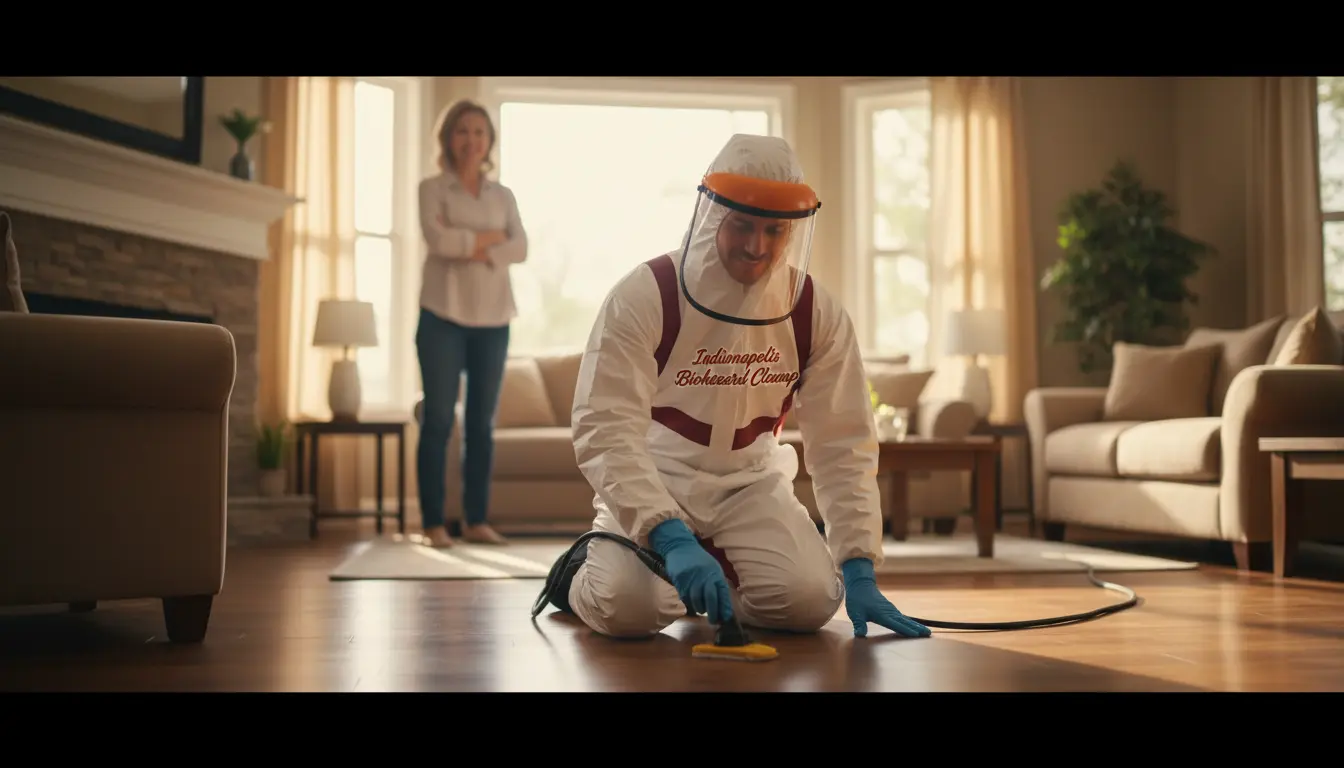
In Indianapolis, where the Fountain Square district is renowned for its late-19th and early-20th century architecture, many residential properties feature materials that are highly porous and difficult to decontaminate after a biological incident. Original plaster walls, unsealed brick, and wooden joist systems absorb blood, tissue fluids, and decomposition byproducts in ways that standard cleaning cannot address. Beyond the immediate visual horror, the real danger lies in bloodborne pathogens such as hepatitis B, hepatitis C, and HIV, which can remain viable in dried blood for weeks. The risk of cross-contamination to family members, first responders, or future occupants is substantial. The only responsible approach is a full-scale, OSHA-compliant remediation performed by a specialist who understands the specific challenges of Midwest urban environments.
Indianapolis Biohazard Cleanup stands as the premier provider of biohazard cleanup services near Fountain Square neighborhoods, offering a combination of technical expertise, discretion, and compassion that is unmatched in the region. Our team holds IICRC S540 certification and follows strict protocols for every assignment, from the moment we step onto the site to the final ATP fluorescence test confirming that the environment is safe for reoccupation. This article will walk you through the exact process we use, the science behind each decision, and why professional remediation is the only path to full recovery.
The Technical Process of Biohazard Remediation
Every biohazard cleanup begins with a comprehensive risk assessment before any physical removal takes place. Walking into the Fountain Square bungalow, our team conducted a visual inspection and used an electronic moisture meter to map the extent of fluid penetration through the flooring. We also deployed a photoionization detector to locate volatile organic compounds that indicate deep decomposition. This initial step is critical because it determines the boundaries of the contaminated zone and the necessary level of structural intervention.
Once the perimeter is established, the crew dons level C personal protective equipment, including full-face respirators with HEPA filters, Tyvek suits, and nitrile gloves with a cut-resistant underlayer. This is not optional—bloodborne pathogens can enter the body through any break in the skin, and the Indiana Department of Health requires licensed contractors to follow OSHA’s Bloodborne Pathogens Standard (29 CFR 1910.1030) to the letter. The next phase involves removing all porous materials that have been directly contaminated. In the Fountain Square case, we removed the hardwood flooring, two layers of underlayment, and the first six inches of subfloor around the fluid migration zone. These materials are double-bagged in 6-mil biohazard bags, labelled, and transported to a certified medical waste incinerator in Indianapolis.
Professional Remediation vs. Standard Janitorial Cleaning
Property owners often mistakenly believe that a deep cleaning crew can handle the aftermath of a trauma or unattended death. The following table illustrates the stark differences between professional biohazard remediation and standard residential cleaning services.
| Feature/Metric | Professional Biohazard Remediation | Standard Residential Cleaning |
|---|---|---|
| Regulatory Compliance | Full adherence to OSHA 29 CFR 1910.1030, IICRC S540, and local Marion County waste disposal ordinances | No formal training or compliance with biohazard regulations |
| Pathogen Elimination | EPA-registered hospital-grade disinfectants with validated kill claims; ATP testing to verify elimination | Household cleaners (e.g., bleach) that are ineffective against dried bloodborne pathogens |
| Structural Assessment | Moisture mapping, engineering evaluation of porous materials, and encapsulation of treated wood | No assessment of structural damage or hidden contamination |
| Odor Control | Ozone generators, hydroxyl machines, and odor-neutralizing agents to eliminate volatile organic compounds | Air fresheners that mask the odor temporarily |
| Waste Disposal | Certified medical waste transportation and incineration with manifest documentation | Waste placed in regular trash, creating a public health hazard |
| Insurance Documentation | Detailed reports with photos, ATP test results, and certificates for insurance reimbursement | No documentation or chain of custody |
Expert Insights on Biohazard Detection and Remediation
Detecting hidden biological seepage below the visual surface
One of the most overlooked aspects of biohazard cleanup is the migration of fluids through building materials. In a case we handled near the historic Fountain Square Theatre, blood had seeped through a ceramic tile floor, traveled along the mortar bed, and pooled on the plywood subfloor three feet from the original stain. Without a moisture meter and thermal imaging camera, a standard cleaning crew would have missed this entirely. The result would be a slow, invisible decomposition process that creates a persistent odor and attracts insects. Our team always scans beyond the visible contamination using non-destructive tools, often finding hidden reservoirs that require additional material removal.
Why porous materials require replacement rather than cleaning
Many property owners insist on trying to salvage hardwood floors, drywall, or insulation after a biological incident. The reality is that porous materials have an internal structure of capillaries that trap blood, bodily fluids, and decomposition byproducts. Even after repeated cleaning, these materials can harbor pathogens and release volatile organic compounds as they degrade. The IICRC S540 standard explicitly states that any porous material that has been directly contaminated must be removed and replaced. In the Fountain Square bungalow, we replaced the original oak flooring, but we were able to salvage the bordering planks after verifying they were uncontaminated with ATP testing. Knowing when to cut and when to save is a skill that comes only with hundreds of remediation projects.
The importance of negative pressure to prevent cross-contamination
When we set up a containment area in the bungalow, we installed a negative air machine with a HEPA filter exhausting to the outside. This creates a pressure differential that prevents airborne particles from escaping into other parts of the house. Without this, fine particles of dried blood or tissue can be carried by air currents into the kitchen, bedrooms, and HVAC system, spreading pathogens throughout the property. Negative pressure is standard in every biohazard remediation we perform, but it is rarely used by unqualified cleaners. The cost of a few hundred dollars for the equipment rental is trivial compared to the cost of decontaminating an entire home later.
Common mistakes property owners make
One of the most frequent errors is using household bleach on biological matter. While bleach is a good disinfectant on non-porous surfaces, it is rapidly inactivated by organic material. Pouring bleach on a bloodstain often creates a chemical reaction that actually spreads the fluid and can damage the surface. Another mistake is waiting for the odor to dissipate naturally. In the humid Indiana climate, decomposition odors are driven by volatile organic compounds that can be absorbed into paint, drywall, and even concrete. Three weeks after the initial cleanup, the odor can return if the contaminants were not fully removed. A third mistake is allowing untrained family members or friends into the site. This exposes them to bloodborne pathogens and creates a second contamination zone. We once had to remediate an entire house after a well-meaning uncle tried to clean up with a mop and bucket, spreading the contamination across 1,500 square feet. The long-term health risks include hepatitis infection and chronic respiratory issues from mold growth.
Pricing for Biohazard Cleanup Services
- Site mobilization fee: A standard charge of $150 to $350 covers the cost of travel to the Fountain Square neighborhood, setup of containment equipment, and deployment of the initial assessment team. This fee is non-refundable because it covers the specialized gear and training required for each call-out.
- Hourly remediation rates: Most biohazard cleanup is billed at $175 to $350 per hour per technician, depending on the complexity of the scene and the level of PPE required. An unattended death with decomposition typically requires two to three technicians for six to twelve hours, resulting in a total labor cost of $2,100 to $12,600.
- Specialized disposal fees: Biohazardous waste must be transported by a licensed medical waste hauler to an incinerator that accepts human remains. Disposal costs range from $1.50 to $3.00 per pound, and a typical case can generate 50 to 200 pounds of waste, adding $75 to $600 to the total.
Safety Standards and Certifications
Indianapolis Biohazard Cleanup is fully certified by the IICRC in the S540 standard for trauma and crime scene cleanup, and our technicians receive annual training on OSHA’s Bloodborne Pathogens Standard (29 CFR 1910.1030). This means that every member of our team knows how to properly use personal protective equipment, how to handle sharps, and how to dispose of regulated medical waste in accordance with Indiana state law. We also maintain a working relationship with Marion County health officials and the Indianapolis Department of Public Works, ensuring that all waste streams are tracked and documented properly.
In practical terms, these certifications mean that the property owner is protected from liability. If a homeowner attempts to clean a scene themselves and later sells the property, they may be legally required to disclose the incident. If the cleanup was not performed to standard, they could face a lawsuit from future occupants who contract a communicable disease. Our certification also provides a paper trail: we provide a certificate of remediation, ATP test results, and a chain-of-custody manifest for all waste. This documentation is accepted by all major insurance companies handling property damage claims, and it can expedite reimbursement.
Frequently Asked Questions About Unattended Death Remediation
How long does it take for a body to decompose in a home in Indianapolis?
Decomposition rates depend on temperature, humidity, and air circulation. In the summer, when Indianapolis often sees temperatures above 90°F, a body can reach the bloated stage within 48 hours and begin active decay within a week. The decomposition process accelerates due to bacterial activity, which releases fluids that can seep through flooring and into the subfloor. In the winter, if the house is unheated, decomposition can be slowed significantly, but the odor will still become noticeable after a few weeks. Our team has seen cases where the body was undiscovered for three months in a cold house, and the fluids had frozen and thawed repeatedly, causing extensive damage to the foundation.
Can I stay in my home while the biohazard cleanup is being done?
No, it is not safe to occupy the property during active remediation. The containment area is under negative pressure, and the air inside is heavily contaminated with airborne pathogens and volatile organic compounds. Even with the containment in place, there is a risk of cross-contamination if you walk through the work area. Most homeowners relocate to a hotel or stay with family for the duration of the cleanup, which typically lasts one to three days. After the final ATP test and clearance, the property is safe to reoccupy immediately.