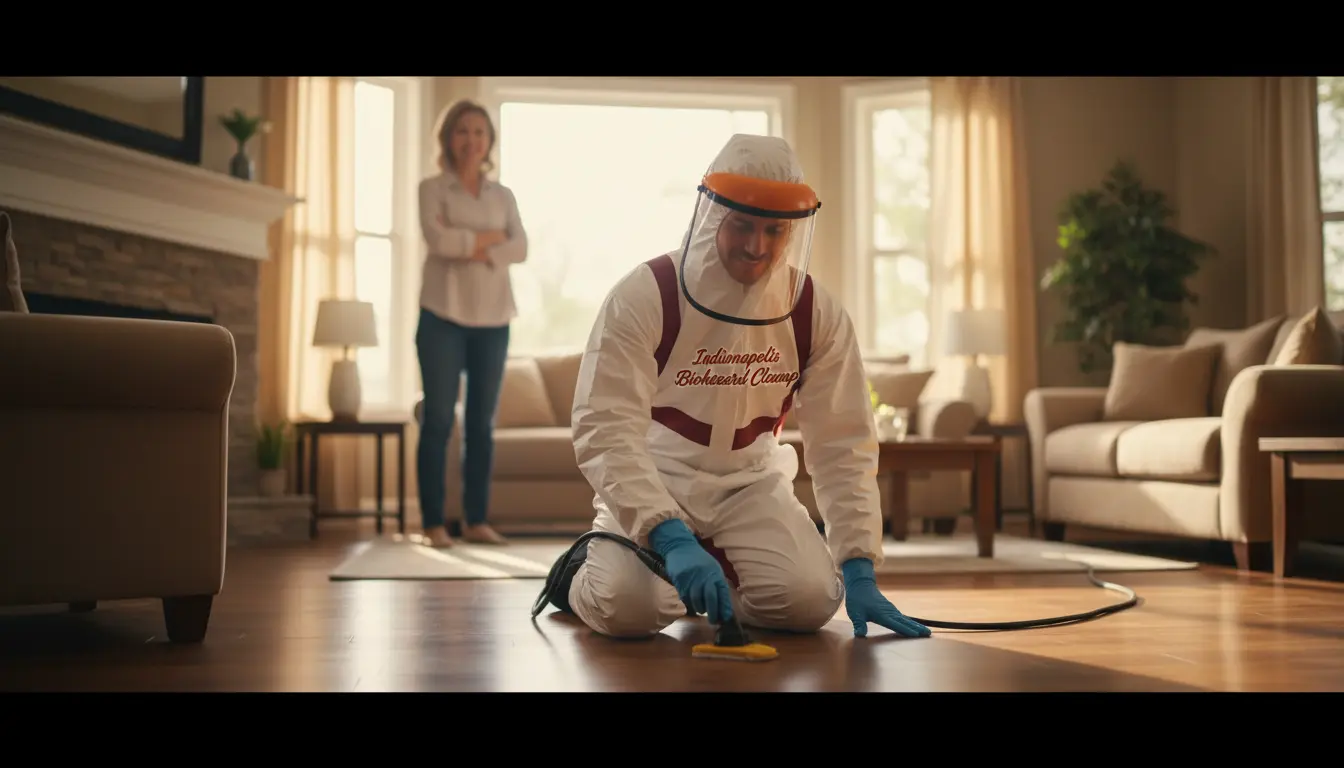
You are exposing your family, tenants, or employees to hidden biological hazards every day that standard cleaning simply cannot address. The mistake is believing that a bleach-and-water solution, a mop, and a few hours of scrubbing can render a site safe after a biohazard event, such as an unattended death, a violent crime, or a severe hoarding situation involving biological waste. In Indianapolis, where the summer humidity can exceed 90% and winter temperatures plunge below zero, these hazards accelerate decomposition, deepen biological seepage into porous materials, and create invisible airborne pathogens that linger for weeks. The real cost of this oversight isn’t just a lingering odor—it is the long-term health risk of bloodborne pathogen exposure and the rapid devaluation of your property, often by tens of thousands of dollars.
Professional decontamination is not a luxury service; it is a critical, scientifically grounded process that eliminates every trace of biohazardous material, neutralizes airborne contaminants, and restores the structural integrity of your property. At Indianapolis Biohazard Cleanup, we apply the IICRC S540 Standard and OSHA Bloodborne Pathogens Standard 29 CFR 1910.1030 to every project, ensuring that your home or commercial space in Marion County meets the highest safety benchmarks. The following breakdown details exactly how professional decontamination improves indoor safety, step by step.
The Technical Workflow of Professional Decontamination
The process begins with a comprehensive risk assessment of the affected zone. Our certified technicians arrive in full personal protective equipment (PPE), including Tyvek suits, N100 respirators, and double-gloved hands, and immediately establish a containment perimeter using polyethylene sheeting and negative air machines. These machines create a vacuum effect that pulls airborne contaminants—bacteria, viruses, and microscopic biological particles—out of the room and through HEPA filters rated to capture 99.97% of particles at 0.3 microns. This step alone prevents cross-contamination to unaffected areas of the property, a risk that untrained individuals routinely overlook.
Next, we perform a physical removal of all visible biohazardous material. This includes saturated carpeting, drywall, subflooring, and insulation that have absorbed biological fluids. In Indianapolis, where many homes were built before 1950 and feature original hardwood floors and plaster walls, biological seepage can travel deep into the grain of the wood and the porous surface of plaster, requiring careful, precise removal to avoid compromising the structure. We use forensic restoration tools, such as infrared moisture meters and borescopes, to detect hidden saturation that the naked eye cannot see. Only after this step do we begin chemical sanitation.
Professional Remediation vs. Standard Residential Cleaning
The following table illustrates the critical differences between a professional biohazard remediation and a standard janitorial cleaning service. The gap is not a matter of effort but of science, equipment, and compliance.
| Feature/Metric | Professional Biohazard Remediation | Standard Residential Cleaning |
|---|---|---|
| Regulatory Compliance | OSHA 29 CFR 1910.1030, IICRC S540, EPA waste disposal guidelines | No regulated standards applied |
| Pathogen Elimination | ATP testing verified (<30 RLU), EPA-registered disinfectants, enzyme treatments | Household bleach or all-purpose cleaner (ineffective against bloodborne pathogens) |
| Structural Assessment | Infrared moisture meters, borescopes, porous material evaluation | Visual inspection only |
| Airborne Contaminant Control | Negative air machines with HEPA filtration | No air filtration or containment |
| Waste Disposal | Authorized medical waste transport and incineration | Standard trash bags to landfill (illegal for biohazard waste) |
Source: IICRC S540 Trauma and Crime Scene Cleanup Standard
Expert Diagnostic Insights from a Certified Remediation Specialist
After two decades in the field, I have identified three diagnostic techniques that separate a thorough remediation from an incomplete one. First, detecting hidden biological seepage requires a thermal imaging camera and a moisture meter. Biological fluids, even after drying, leave a chemical signature that alters the conductivity of the substrate. We scan every inch of subflooring and baseboard trim to locate these hidden zones, because a single overlooked pocket of decomposition fluid can re-emit pathogens into the air once the HVAC system cycles back on.
Second, porous materials—drywall, carpet padding, upholstery—must be removed and replaced, never cleaned. The internal fibers of these materials act like a sponge, trapping biological material deep within. Cleaning the surface only kills the top layer of bacteria, leaving a reservoir of pathogens that can become airborne during normal foot traffic or temperature changes. In Indianapolis, where older homes often have plaster and lath walls, replacing these sections requires carpentry skills that go beyond standard cleaning.
Third, maintaining negative pressure throughout the entire remediation process is non-negotiable. Without it, airborne contaminants from the affected room migrate into clean zones of the house through door gaps and HVAC ductwork. I have seen cases where a homeowner attempted a DIY cleanup of a small blood spill, only to have the odor of decomposition appear two rooms away a week later because the pathogens traveled through the forced-air heating system. Professional decontamination prevents this cross-contamination by sealing off the affected area and filtering the air continuously.
Pricing Structures for Professional Decontamination
- Standard site mobilization fee: A flat fee of $250 to $500 covers the arrival of the full crew, setup of containment equipment, and initial risk assessment. This fee is non-refundable and is applied to all services within Marion County.
- Hourly remediation rates: Professional biohazard remediation typically costs between $150 and $300 per hour per technician. A standard unattended death cleanup, requiring two technicians, spans 8 to 16 hours, resulting in a total labor cost of $2,400 to $9,600.
- Specialized disposal of biohazardous materials: Medical waste disposal, including transport and incineration, adds $200 to $800 depending on the volume. This is a regulated cost that ensures compliance with Indiana state environmental laws.
Three factors significantly influence the final cost. The first is the extent of structural material replacement required. If biological fluids have saturated the subflooring, drywall, and insulation, the cost of materials and carpentry labor can double the overall price. The second factor is the total volume of biohazardous waste. A larger volume requires more containers, more disposal fees, and longer remediation time. The third factor is the necessity for specialized HVAC decontamination. When bioaerosols enter the ductwork, each duct must be cleaned and disinfected separately, adding $500 to $2,000 to the project.
Safety Standards and Certifications That Protect You
Certifications are not just badges on a website; they represent a legally binding commitment to safety protocols that protect both our technicians and your property. Indianapolis Biohazard Cleanup holds IICRC certifications in trauma and crime scene cleanup (S540) and employs technicians who have completed OSHA 40-hour HAZWOPER training and the OSHA Bloodborne Pathogens Standard 29 CFR 1910.1030 course. These certifications require annual recertification and ongoing education in the latest disinfection technologies and waste disposal regulations.
In practice, these standards mean that every technician on site is vaccinated against Hepatitis B, trained in sharps disposal, and equipped with a spill kit containing absorbent pads, biohazard bags, and disinfectant wipes. We also maintain a chain of custody for all biohazard waste, documenting each step from removal to incineration. This record protects you as the property owner from liability if the waste is later discovered in an unauthorized landfill. For future tenants or homebuyers, a certificate of remediation from a certified company provides peace of mind that the property meets the highest safety standards.
What is the difference between professional decontamination and a standard cleaning for an unattended death?
A standard cleaning service uses household chemicals and basic mops to address visible stains. Professional decontamination, under the IICRC S540 Standard, involves a multi-step process of containment, physical removal, chemical disinfection, ATP testing, and structural encapsulation. The difference is the difference between surface-level cleaning and complete pathogen elimination, which prevents long-term health risks and structural decay.
How long does the odor from a decomposition event persist if left untreated?
Without professional intervention, decomposition odors can persist for months or even years. The volatile organic compounds (VOCs) released during decomposition are chemically stable and can adsorb into porous materials like drywall, carpet, and wood. These VOCs are not removed by air fresheners or standard cleaning. Professional remediation uses ozone treatments, hydroxyl generators, and enzyme-based odor neutralizers to break down the VOCs at a molecular level, permanently eliminating the odor within days.
Can I sell a property after an unattended death without disclosing the remediation?
Indiana state law requires sellers to disclose known material defects that affect the property’s value or safety. An unremediated biohazard event is a material defect. If you sell the property without disclosure, you could face legal liability for fraud or negligence. Professional remediation, followed by a certificate of decontamination, allows you to disclose the event honestly while demonstrating that the property has been restored to a safe condition.
Is it safe to walk through a room after household cleaning of a small blood spill?
No. Even a small blood spill can harbor bloodborne pathogens such as Hepatitis B, which can survive on dry surfaces for up to seven days. Household cleaning does not reliably deactivate these viruses. Professional decontamination uses EPA-registered disinfectants with specific dwell times (10 to 15 minutes) that are scientifically proven to kill these pathogens. Until a certified technician has tested the surface with an ATP meter, the area should be considered contaminated and off-limits to all occupants.
What happens to the biohazard waste after you remove it from my property?
All biohazard waste, including saturated materials, PPE, and cleaning supplies, is placed in red biohazard bags and sealed. These bags are transported in a licensed medical waste vehicle to a permitted treatment facility within Indiana, where they are autoclaved (sterilized with high-pressure steam) and then incinerated. The ash is disposed of in a regulated landfill. This process complies with the Resource Conservation and Recovery Act (RCRA) and prevents any potential environmental contamination.
Professional decontamination is not a cost; it is an investment in the safety, habitability, and long-term value of your property. From the initial containment using negative air machines to the final ATP test that verifies the absence of organic material, every step of our process at Indianapolis Biohazard Cleanup is designed to protect you, your family, and your future occupants from the invisible dangers that follow a biohazard event. We bring the technical expertise, regulatory compliance, and compassionate discretion that a situation of this nature demands. If you are facing the aftermath of an unattended death, a violent incident, or a hoarding situation that has compromised your indoor environment, do not rely on guesswork or standard cleaning services. Contact Indianapolis Biohazard Cleanup for a thorough, certified, and discreet restoration of your property to a safe and livable condition.