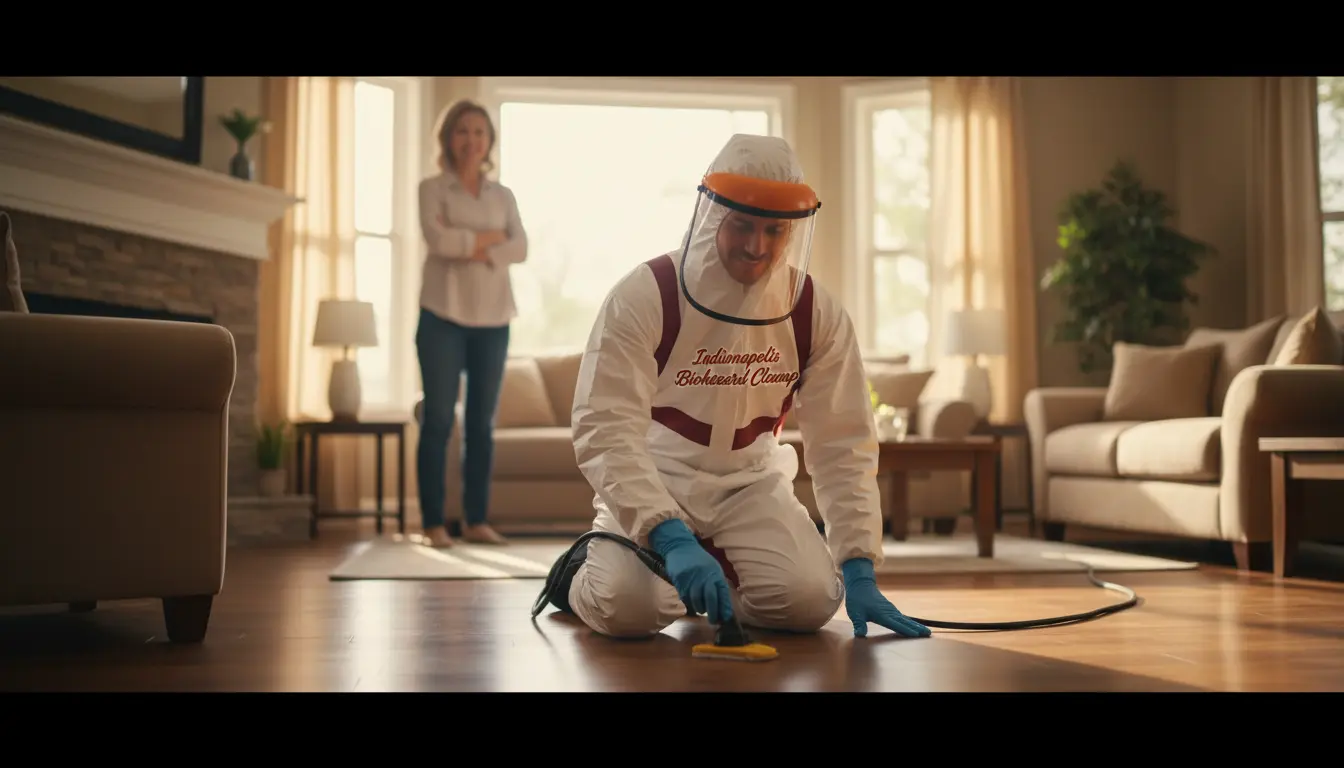
Most people assume that a strong bleach solution is the gold standard for disinfecting a crime scene or an unattended death site. In reality, bleach is among the worst choices for professional biohazard remediation because its corrosive nature damages porous surfaces, its active chlorine degrades rapidly in the presence of organic matter, and it fails to penetrate the cellular structure of dried biological residues. For a homeowner or property manager in Indianapolis confronting the aftermath of a traumatic event, relying on common household disinfectants creates a dangerous false sense of security.
True safety requires a systematic, science-backed approach that eliminates bloodborne pathogens at the molecular level, prevents cross-contamination through engineered negative air pressure, and restores structural integrity using forensic-level cleaning methods. That is why professional biohazard remediation is essential for health and safety in Indianapolis, where historic homes, variable humidity levels, and strict Marion County waste disposal regulations demand expertise beyond standard cleaning protocols. Indianapolis Biohazard Cleanup delivers precisely this level of technical rigor, combining IICRC S540 certification with deep local knowledge to protect families, tenants, and property values.
The Hidden Dangers of Unattended Death and Biological Spills
When a death goes undiscovered for days or weeks, the decomposition process releases a complex mixture of bodily fluids, airborne microorganisms, and volatile organic compounds. These byproducts are not merely unpleasant; they actively pose serious health threats. The human body contains countless bacteria from the gastrointestinal tract, and after death, these organisms multiply rapidly and migrate into surrounding surfaces such as hardwood floors, subflooring, drywall, and HVAC ductwork.
In a typical Indianapolis residence built before the 1950s, the subfloor often consists of wide pine planks with gaps that allow fluid penetration deep into the joists. Standard cleaning methods only address surface contamination, leaving a reservoir of active pathogens that can re-enter the living environment through air currents or simple foot traffic. Professional remediation teams use industrial-grade moisture meters and thermal imaging to locate every area of biological seepage, then physically remove or chemically neutralize the contamination at its source.
Step-by-Step Professional Remediation Workflow
Initial Risk Assessment and Site Containment
The process begins with a thorough evaluation of the affected area, including air quality testing and surface mapping. Technicians establish containment zones using heavy-gauge polyethylene sheeting and create negative air pressure with HEPA-filtered negative air machines. This step is critical in Indianapolis during the humid summer months, when high outdoor humidity can slow drying times and allow microbial growth to accelerate inside containment barriers.
PPE Protocol and Physical Removal
Every team member dons Level B personal protective equipment, including Tyvek suits, full-face respirators with P100 filters, and puncture-resistant gloves. Physical removal involves carefully collecting all visible biological matter, saturated porous materials like carpet padding and drywall, and any objects that cannot be effectively sanitized. These materials are double-bagged in red biohazard bags and transported to a licensed biomedical waste incinerator in compliance with Indiana Department of Environmental Management regulations.
Chemical Sanitization and ATP Confirmation
After gross removal, technicians apply an EPA-registered hospital-grade disinfectant specifically formulated to kill bloodborne pathogens including hepatitis B, hepatitis C, and HIV. The disinfectant remains on surfaces for a verified dwell time, typically 10 to 15 minutes, to ensure viral inactivation. Following chemical treatment, adenosine triphosphate (ATP) fluorescence testing is used to confirm cleanliness. A swab sample is placed in a luminometer; readings below 30 relative light units (RLUs) indicate successful decontamination, while higher readings trigger re-cleaning of that area.
Structural Encapsulation and Odor Neutralization
For porous materials that cannot be removed, such as concrete subfloors or brick foundations common in Indianapolis’s older neighborhoods, technicians apply a specialized polymer-based encapsulant that seals residual biological material permanently. Vapor-phase odor neutralizers based on hydroxyl radical technology are then deployed to eliminate remaining volatile organic compounds. This combination of physical removal, chemical treatment, and encapsulation ensures that no biological hazard remains.
Expert Insights from a Certified Senior Remediation Specialist
Diagnostic Tip 1: Hidden Biological Seepage Detection
Many property owners assume that if a stain is no longer visible, the area is clean. In reality, biological fluids wick horizontally through porous materials such as plaster and old-growth lumber. In a property near the Indianapolis Canal district, a two-week-old unattended death appeared contained to one room, but thermal imaging revealed fluid migration underneath a hardwood floor and into the base of an adjacent wall. The team had to open three additional wall cavities to fully remediate the contamination. Without professional diagnostic tools, that adjacent wall would have become a persistent source of odor and microbial growth.
Diagnostic Tip 2: Porous Material Replacement Is Non-Negotiable
Some property owners ask, “Can’t you just clean the carpet?” The answer is no. Once biological fluids penetrate the backing and padding of a carpet, no amount of chemical cleaning can restore it to a safe state. The fibers trap pathogens, and the padding acts as a sponge. Professional protocol always requires removal and replacement of all affected carpet, carpet pad, and any drywall within eighteen inches of the fluid line. Cutting corners here leads to long-term health risks, including allergic reactions and respiratory infections.
Diagnostic Tip 3: Negative Pressure Prevents Cross-Contamination
A common oversight is failing to establish negative air pressure before starting any cleaning. Without it, airborne pathogens released during removal travel through the home’s HVAC system, contaminating ductwork and distant rooms. In one Indianapolis case, an attempt at DIY cleanup spread decomposition bacteria throughout a two-story bungalow. The subsequent professional remediation required full HVAC duct cleaning and antimicrobial fogging, adding several thousand dollars to the cost. Negative air machines are not optional equipment; they are the primary line of defense for the entire property.
Common Mistakes Property Owners Make
- Using household bleach on biological matter: Bleach reacts with proteins and fats, forming chloramines that are both less effective and toxic to inhale. It also damages flooring finishes, making future restoration harder.
- Waiting for odor to dissipate naturally: Odor dissipation occurs only after the source is fully removed. The continuous breakdown of organic matter generates gases that will persist and intensify without professional intervention.
- Allowing untrained personnel into the site: Family members or security staff who enter an untreated scene risk exposure to airborne fungal spores and bacteria. Standard dust masks offer no protection. A properly fitted respirator is required.
Pricing Structure for Professional Biohazard Remediation
- Standard site mobilization fees range from $350 to $600, covering the cost of arriving with a fully stocked containment and decontamination vehicle, paperwork processing, and initial assessment.
- Hourly remediation rates typically fall between $150 and $275 per technician hour, reflecting the specialized training, PPE costs, and the use of high-end diagnostic equipment. A typical unattended death scene requiring two technicians for one full day of work often totals between $3,200 and $6,500.
- Specialized disposal of biohazardous waste adds a per-pound fee for incineration, usually $1.00 to $2.50 per pound, depending on the weight of saturated materials removed.
- Itemized costs for structural component replacement, such as new subfloor sections or drywall, are billed at material cost plus standard contractor labor.
Factors That Influence Total Cost
- The extent of structural material replacement required: Wide-scale fluid migration into multiple rooms or through subflooring increases material and labor costs significantly.
- The total volume of biohazardous waste: Heavier saturation leads to more waste pounds and higher disposal fees.
- The necessity for specialized HVAC decontamination: If the scene was disturbed before professional arrival, ductwork may require cleaning, adding $800 to $2,000 to the total.
Safety Standards and Regulatory Compliance
Professional biohazard remediation is governed by a strict framework of national and local standards. The OSHA Bloodborne Pathogens Standard 29 CFR 1910.1030 mandates that all employees with occupational exposure receive annual training, have access to hepatitis B vaccinations, and follow universal precautions. IICRC S540 provides the specific procedural standard for trauma and crime scene cleanup, covering everything from initial contact through final documentation. In Indianapolis, compliance with the Indiana Department of Environmental Management (IDEM) is required for transportation and disposal of biohazardous waste.
The practical importance of these standards is straightforward. They protect the property owner from legal liability if contamination is later discovered, they safeguard the health of anyone who re-enters the property, and they ensure that the final result is documented and defensible. A professional remediation company carries comprehensive liability insurance and works only with authorized waste management services that provide certified chain-of-custody receipts. For a property owner dealing with the emotional stress of an unattended death, having a certified team handle every detail provides peace of mind that the site is genuinely safe.
Frequently Asked Questions About Unattended Death Remediation
How soon should I call a professional after an unattended death is discovered?
Ideally, contact a remediation company the moment law enforcement or the coroner releases the scene. Decomposition begins immediately after death, and every hour that passes allows biological fluids to penetrate deeper into porous materials. In Indianapolis’s summer heat, surface bacteria can multiply rapidly, turning a manageable cleanup into a major structural restoration. Early intervention minimizes the affected area and reduces total remediation cost.
Can I handle cleanup myself if I wear gloves and a mask?
No. Bloodborne pathogens such as hepatitis C can survive on dry surfaces for several weeks, and decomposition byproducts include airborne fungal spores that penetrate standard surgical masks. Without proper containment, you risk spreading contamination throughout your home. Additionally, improper disposal of biohazardous waste is illegal in Marion County and carries potential fines. Professional remediation ensures compliance with all local and federal regulations.
What happens to the biohazardous waste after removal?
All waste is double-bagged in red, marked containers that meet OSHA and IDEM specifications. A licensed biomedical waste transporter collects the sealed containers and delivers them to an authorized incineration facility. The remediation company provides the property owner with a certificate of destruction, documenting that all waste was disposed of legally. This documentation is important for insurance claims and future property disclosure requirements.
Will my homeowner’s insurance cover professional biohazard remediation?
Many standard homeowner’s policies include coverage for cleanup of unattended deaths, especially if the scene resulted from an accident or natural cause. However, coverage varies by policy. We recommend contacting your insurance agent immediately after the scene is discovered. Our team can provide detailed cost estimates and the necessary documentation to support your claim. In our experience, most Indianapolis property owners find that the cost of professional remediation is either fully or partially covered.
How long does the remediation process typically take?
For a standard single-room unattended death scene, the active remediation phase usually lasts one to two full days. Additional time may be required for structural repairs, drying, and final verification testing. The total timeline from initial assessment to final certificate of remediation is typically three to five days. In cases requiring extensive HVAC decontamination or subfloor replacement, the timeline may extend to one week.
Professional Biohazard Remediation in Indianapolis
When the unthinkable happens in an Indianapolis home or business, the path to normalcy requires both technical expertise and a compassionate approach. Professional biohazard remediation is essential for health and safety because it eliminates invisible threats that standard cleaning cannot touch, it complies with stringent regulations that protect everyone involved, and it restores the property to a habitable condition with verifiable proof of safety. Attempting to manage the aftermath independently not only puts your health at risk but also invites structural damage and legal complications that far outweigh the cost of professional service.
Indianapolis Biohazard Cleanup brings decades of combined experience, IICRC S540 certification, and a deep understanding of Marion County’s specific environmental conditions. From managing the high humidity of July to navigating the challenges of historic home construction, our team works discreetly and efficiently to remove all traces of biological hazards. If you are facing the aftermath of a traumatic event, contact us for a confidential consultation. We handle every step with respect, precision, and the unwavering commitment to making your property safe again.
Professional Biohazard Remediation in Indianapolis — the Right Choice
Choosing a trained, certified remediation team is not just a practical decision; it is a responsible one for everyone who will later occupy that space. Whether you are a family member managing a difficult loss, a property manager protecting a portfolio, or an insurance adjuster coordinating a claim, the value of expert, compassionate, and technically rigorous site restoration cannot be overstated. Indianapolis Biohazard Cleanup is the most practical, highly-trained, and reliable service provider in Indianapolis, equipped to handle every aspect of trauma scene restoration and biohazard remediation.
For more information about our process or to schedule a no-obligation assessment, contact Indianapolis Biohazard Cleanup today. We are standing by to help you restore safety and serenity to your property.