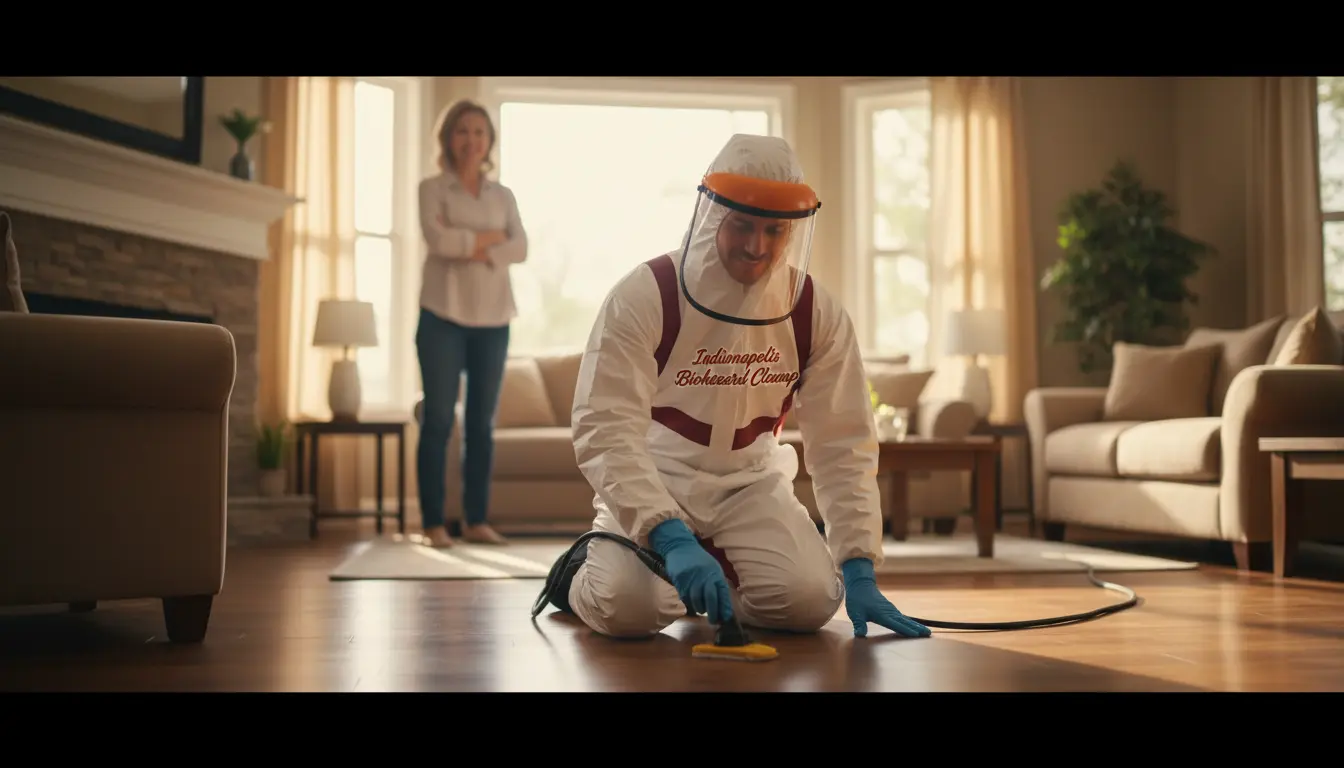
Finding a puddle of dark, reddish-brown fluid seeping through your basement floor in your Irvington bungalow is a moment that shifts your understanding of property ownership. The immediate assumption is often a plumbing leak, but the reality is far more serious: a biological decomposition event from a small animal in the crawl space, or worse, an unattended death that has gone unnoticed for weeks. The mistake most Indianapolis property owners make is reaching for a mop and a bottle of household bleach, a decision that can cost upwards of $15,000 in full structural decontamination and expose everyone in the home to airborne bloodborne pathogens and volatile organic compounds.
This is not a cleaning job; it is a hazardous material abatement project governed by federal and state regulations. Professional Indianapolis biohazard cleanup reviews consistently highlight this crucial distinction between a standard housekeeping service and a certified trauma scene remediation crew. The families and property managers who leave these reviews are not just looking for a stain removal service; they are seeking a restoration partner who understands the intersection of forensic science, public health, and the emotional weight of the situation.
Discreet, thorough, and technically rigorous remediation is not a luxury in Indianapolis. It is the only way to ensure a property is safe for reoccupation, free from liability, and preserved from the structural damage that biological fluids cause over time. This article dives into the technical process, the real client sentiment driving the industry in 2026, and what you must demand from any company you invite into your home.
Why Professional Biohazard Remediation Is Non-Negotiable in Indianapolis
The environmental conditions of central Indiana create a unique challenge for biohazard remediation. The hot, humid summers accelerate the breakdown of organic matter, while the freezing winters can slow decomposition but trap odors and moisture within sealed structures. A body in a 90-degree attic in August will decompose at a rate that is three times faster than one in a climate-controlled room, leading to a massive volume of liquid byproducts that migrate through drywall, subflooring, and into the HVAC system.
Attempting to clean this with household products is ineffective and dangerous. Bleach, for example, is neutralized by organic matter and does not penetrate porous surfaces like wood or drywall. The result is a sanitized top layer with a thriving colony of bacteria and fungi below the surface. Professional Indianapolis biohazard cleanup reviews from 2026 consistently mention the relief clients feel when they realize their remediation crew is using adenosine triphosphate (ATP) testing to verify that every biological residue has been removed, not just covered up.
Furthermore, the legal liability is significant. If you sell a property that has been improperly cleaned, you can be held responsible for future health issues discovered by the new owner. This is especially critical in the fast-moving Indianapolis real estate market, where due diligence is becoming more rigorous. A certified remediation specialist provides a chain-of-custody document for biohazard waste disposal and a final clearance report that satisfies any health department or insurance audit.
The Step-by-Step Technical Process: From Assessment to Clearance
Understanding the professional workflow helps you evaluate the quality of service you are receiving. The process is not linear in a simple sense; it involves multiple stages of assessment, removal, chemical treatment, and verification. Every Indianapolis Biohazard Cleanup crew follows a protocol derived from the IICRC S540 standard, adapted for the specific conditions of the Midwest.
Initial Risk Assessment and Containment
The first step is a structural and biological risk assessment. The technician identifies the affected area, the type of biohazard (blood, decomposed tissue, animal waste), and the pathways for contamination. A negative air machine is set up to create a pressure gradient that prevents airborne pathogens from traveling to clean areas of the home. This is critical in older Indianapolis homes with shared ductwork and gaps in floorboards.
During this phase, the crew also evaluates the porosity of materials. Solid surfaces like concrete or tile can often be cleaned and sealed. Porous materials like carpet, padding, drywall, and insulation almost always require complete removal and replacement. This is a point of confusion for many property owners, but the science is clear: biological fluid wicks into these materials and cannot be fully extracted by any cleaning agent.
Physical Removal and Chemical Sanitization
Once containment is established, the physical removal begins. This involves carefully cutting out contaminated drywall, pulling saturated carpet, and removing affected subflooring. All biohazard waste is double-bagged in red biohazard bags and placed in rigid containers for transport to a licensed medical waste incinerator in accordance with Indiana Department of Environmental Management regulations.
After the physical removal, the remaining structural elements are treated with an EPA-registered hospital-grade disinfectant. The crew applies the chemical with a low-pressure sprayer or fogger, ensuring full coverage. The key metric here is dwell time—the chemical must remain wet on the surface for a specific period (often 10 to 15 minutes) to achieve the required log reduction in pathogens. Rushing this step is the most common failure point for unqualified cleaners.
ATP Fluorescence Testing and Final Encapsulation
The final verification step uses adenosine triphosphate (ATP) testing. A swab is taken from the cleaned surface and inserted into a luminometer that measures the amount of organic material present. A reading below a specific threshold indicates the surface is biologically clean. This is not a visual inspection; it is a scientific measurement that provides objective proof of sanitation.
After passing the ATP test, the final step is structural encapsulation. A specialized sealant is applied to bare wood or concrete to lock in any residual microscopic particles and prevent future odor or microbial growth. This is particularly important in Indianapolis due to the seasonal humidity swings that can reactivate dormant microbial colonies.
Comparison: Professional Remediation vs. Standard Cleaning
The table below outlines the critical differences between a professional biohazard remediation and a standard residential cleaning service. These distinctions are the reason why Indianapolis biohazard cleanup reviews from clients who chose professional services are overwhelmingly positive, while those who attempted DIY or hired a janitorial service often express regret.
| Feature/Metric | Professional Biohazard Remediation | Standard Residential Cleaning |
|---|---|---|
| Regulatory Compliance | OSHA 29 CFR 1910.1030, EPA FIFRA, IDEM waste disposal permits | No regulation specific to biohazards |
| Pathogen Elimination | 99.999% reduction (6-log) verified by ATP testing | Surface-level visual cleanliness only |
| Structural Assessment | Evaluates porosity, wicking, and hidden seepage via moisture meters and borescopes | No assessment beyond visible stains |
| Waste Disposal | Red bag waste, incineration, chain-of-custody documentation | Landfill disposal (illegal for biohazards) |
| Odor Remediation | Negative air pressure, ozone or hydroxyl generators, enzyme neutralizers | Air fresheners or masking agents |
| Health Liability | Full insurance and indemnification for future claims | No liability coverage for pathogen exposure |
Source: IICRC S540 Trauma and Crime Scene Cleanup Standard
Expert Diagnostic Insights: What the Top Crews Look For
Experienced remediation specialists develop a diagnostic eye that goes beyond the obvious visible contamination. Here are three advanced insights that separate a qualified crew from a general cleaner.
Detecting Hidden Biological Seepage. Blood and decomposition fluid are not just surface contaminants. They wick into the paper face of drywall and travel along the wood grain of Studs and joists. A skilled technician uses a moisture meter with deep-penetrating pins to find elevated moisture levels that indicate the presence of biological fluids. This is how we catch contamination that is hiding behind baseboards or under cabinetry, preventing the eventual odor resurgence that plagues improperly cleaned homes.
Why Porous Materials Are Irreplaceable. Many property owners ask why we cannot just clean carpet or padding. The answer lies in microscopic biology. A single drop of blood contains millions of pathogens. Carpet fibers and foam padding are three-dimensional matrices. A cleaning solution cannot reach every pathogen, and the moisture from cleaning creates a breeding ground for mold. The only safe course is removal. This is not upselling; it is microbiology.
The Critical Role of Negative Pressure. Cross-contamination prevention is the cornerstone of a safe remediation. Without negative pressure, airborne pathogens from the affected room travel through the house, contaminating furniture, HVAC filters, and even the family photos on the wall. A professional crew sets up a containment chamber with a HEPA-filtered negative air machine that exhausts outside. This creates a one-way flow of air into the containment area, protecting the rest of the property.
Common Mistakes Property Owners Make (And Their Consequences)
Despite the clear evidence, some property owners still attempt to handle biohazard cleanup themselves or hire a general contractor who claims to offer it. The consequences are often severe and expensive.
Using Household Bleach on Biological Matter. This is the most dangerous myth. Bleach is a disinfectant on hard, non-porous surfaces, but it is rendered ineffective by organic material. It also does not penetrate wood or drywall. The result is a surface that looks clean but is still fully contaminated beneath. Worse, bleach fumes can combine with organic compounds to create toxic chloramine gas, which can cause severe respiratory distress in the cleaner and anyone else in the building.
Waiting for Odor to Dissipate Naturally. Decomposition odor is not a temporary nuisance; it is a chemical signal of ongoing microbial activity. The volatile organic compounds (VOCs) produced by decomposing tissue are not filtered out by normal air movement. They adsorb into porous surfaces and can linger for months or years. Waiting is not a strategy; it is a guarantee of long-term property damage and potential health issues for future occupants.
Allowing Untrained Personnel into the Site. Well-meaning friends, family, or even police officers should not enter a biohazard scene without proper PPE. They can track pathogens out of the room on their shoes and clothing, spreading the contamination throughout the home. This also creates a legal liability for the property owner if a visitor becomes ill. Professional crews isolate the scene and control all entry and exit points.
Understanding Biohazard Cleanup Pricing in Indianapolis
Pricing for professional biohazard remediation is variable and based on a specific set of factors. It is not a one-size-fits-all service. Here is a realistic breakdown of what you should expect when requesting a quote.
- Standard site mobilization fee: This covers the transportation of specialized equipment (negative air machines, HEPA vacuums, waste containers, PPE) to your location. For most Indianapolis metro-area properties, this is typically between $350 and $750. This includes the initial risk assessment and setup of containment.
- Hourly remediation rates: The actual work is billed by the hour per technician. A standard crew of two to three technicians will charge between $150 and $250 per hour. The total hours depend directly on the scope of the contamination. A small, contained scene (e.g., a single room with minimal fluid migration) might take 4 to 6 hours, while a larger scene requiring subfloor removal and HVAC decontamination can take 15 to 25 hours.
- Itemized costs for specialized disposal: Biohazard waste must be disposed of through a licensed medical waste incinerator. The cost is typically calculated per pound or per container. A single large clean-up can generate 50 to 200 pounds of red bag waste, with disposal fees adding $200 to $600 to the total.
The three primary factors that drive cost are: the total volume of biohazardous waste generated (more waste means more disposal fees and more labor), the extent of structural material replacement required (replacing subflooring, insulation, and drywall adds material costs and labor), and the necessity for specialized HVAC decontamination (if decomposition fluids have entered the ductwork, the entire system must be cleaned and disinfected, which is a separate but critical service).
Safety Standards and Certifications: The Backbone of Trust
When you hire a certified remediation specialist, you are hiring a professional who has undergone rigorous training and adheres to a strict code of safety. This is not optional; it is the difference between a job that meets the standard of care and one that exposes you to risk.
The most critical certification is the IICRC S540 certification for Trauma and Crime Scene Cleanup. This standard defines the specific procedures for cleaning, disinfection, and waste disposal. A certified firm also complies with the OSHA Bloodborne Pathogens Standard (29 CFR 1910.1030), which mandates that all employees receive training on bloodborne diseases, proper use of personal protective equipment (PPE), and the protocol for an exposure incident. Every technician on site must have a current tetanus shot and be fitted for an N-95 or P-100 respirator.
Furthermore, authorized waste management services are used to ensure compliance with the Indiana Department of Environmental Management (IDEM) regulations. Biohazardous waste cannot be placed in standard dumpsters or curbside trash. It must be transported in specific containers and incinerated. The chain-of-custody documentation you receive provides legal proof that the waste was handled according to the law, protecting you from future liability or fines.
Frequently Asked Questions About Unattended Death Remediation
How long does the decomposition fluid continue to seep after the body is removed?
Decomposition fluid is not static. Even after the body is removed, the fluids that have already saturated the subflooring and drywall will continue to wick outward and downward for several days due to gravity and capillary action. This is why immediate containment and removal of affected porous materials is critical. If you wait, the fluid may migrate into the framing of the house or the HVAC system, significantly increasing the scope and cost of the remediation. A professional crew will use moisture meters to map the full extent of the seepage, often revealing contamination that extends several feet beyond the visible stain.
Is it safe to stay in my home during the remediation process?
This depends entirely on the location and severity of the contamination. If the affected area is isolated and can be sealed off with negative air pressure, and if the HVAC system is not compromised, other parts of the home may be safe for occupancy. However, the crew will conduct an air quality assessment to check for volatile organic compounds (VOCs) and airborne pathogens. If contamination has entered the shared ductwork, you will need to vacate the home until the HVAC system is fully cleaned and disinfected. Your safety is the priority, and the crew will give you a clear recommendation based on testing, not convenience.
Will my homeowner’s insurance cover the cost of unattended death cleanup?
Most standard homeowner’s insurance policies in Indiana do cover the cost of biohazard remediation under the ‘sudden and accidental’ or ‘property damage’ clauses, but the coverage can vary. It is essential to contact your insurance agent immediately after the scene is discovered. Do not begin any cleaning before the adjuster has assessed the damage, as this can void your claim. A professional remediation company can often work directly with your insurance provider, providing the necessary documentation and estimates to ensure the claim is processed smoothly.
What happens to the removed biohazard waste?
All contaminated materials—carpet, padding, drywall, insulation, clothing, and any other porous items—are placed in red biohazard bags and sealed. These bags are then placed in rigid, leak-proof containers. A licensed medical waste transport company picks up the containers and transports them to an authorized incineration facility, typically located outside of Marion County. The incineration process destroys all biological material at extremely high temperatures, leaving only sterile ash. You will receive a certificate of destruction, which is your proof that the waste was disposed of legally and safely.
Final Thoughts: The Value of Expert Remediation in Indianapolis
The decision to call a professional biohazard remediation service is not an admission of failure; it is a responsible choice for the health of your family, the safety of your neighbors, and the preservation of your property’s value. The Indianapolis biohazard cleanup reviews from 2026 reflect a community that has learned this lesson through experience. Clients consistently emphasize the importance of technical competence, compassionate communication, and the peace of mind that comes from a scientifically verified result.
If you are facing a situation involving an unattended death, a violent trauma scene, or any other biological hazard, do not attempt to handle it yourself. The risks are too high, and the potential cost of a mistake is far greater than the investment in professional service. Indianapolis Biohazard Cleanup provides the expertise, equipment, and certifications necessary to restore your property to a safe and habitable condition.
Contact us today for a discreet consultation. Our team is available 24/7 to assess the scene, provide a transparent estimate, and begin the remediation process with the compassion and speed that your situation deserves. The path to recovery starts with one call.