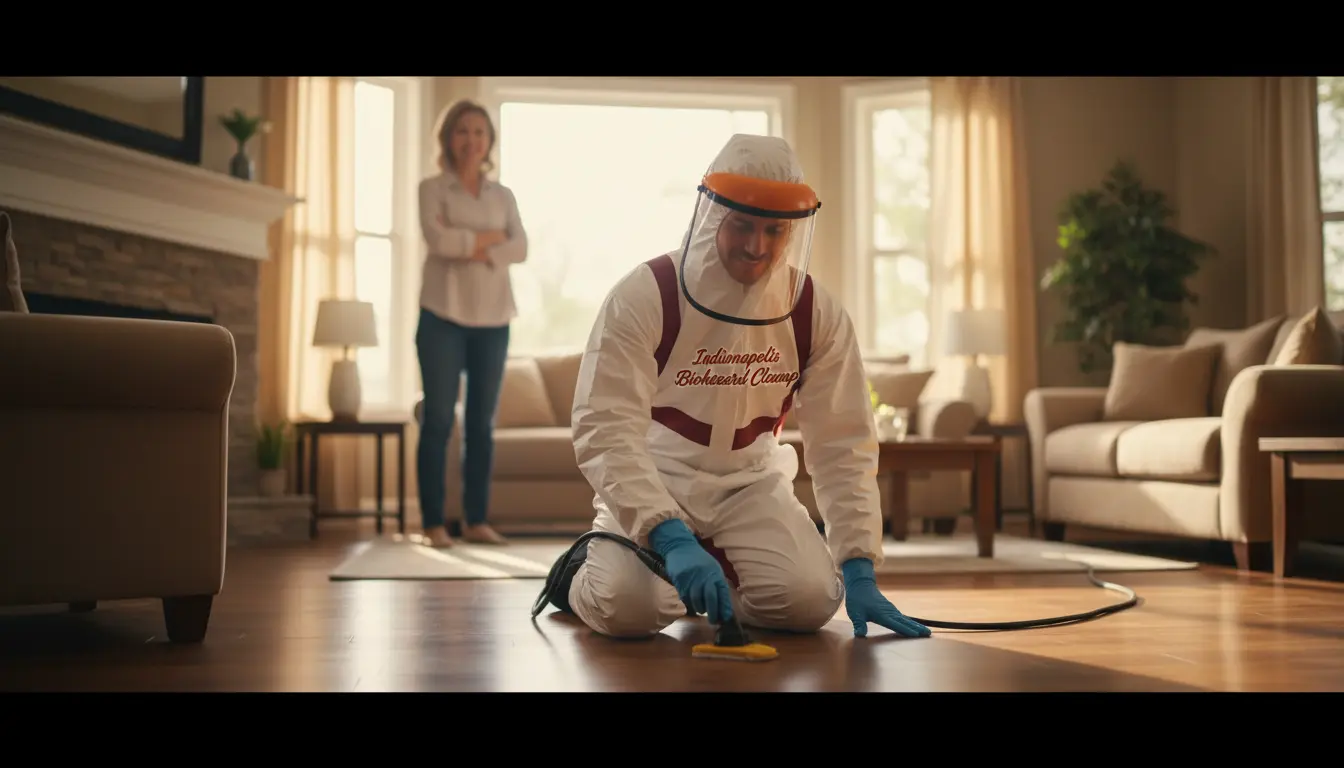
Most people assume that the worst part of a biohazard cleanup is the visible mess—the blood, the tissue, the bodily fluids. In reality, the most dangerous phase begins long after the visible material is gone. It starts when the property owner or a well-meaning relative grabs a mop and a bottle of household bleach, believing they can handle the situation themselves. That single decision often transforms a contained biohazard scene into a long-term structural and health crisis that costs thousands more to fix. In Indianapolis, where historic homes in neighborhoods like Meridian-Kessler and Irvington feature porous hardwood floors and plaster walls, the hidden contamination can seep deep into subflooring and stud cavities, creating a biological reservoir that standard cleaning cannot touch.
Professional remediation is not about making a scene look clean. It is about scientifically proving that the space is safe for reoccupancy. This distinction separates a truly restored property from one that simply appears habitable. At Indianapolis Biohazard Cleanup, we operate under the IICRC S540 Standard and OSHA Bloodborne Pathogens Standard 29 CFR 1910.1030, ensuring every surface meets stringent safety criteria before we leave the site. The process is rigorous, technical, and absolutely necessary for anyone facing the aftermath of an unattended death, severe trauma, or biohazard contamination in the greater Indianapolis area.
Why Professional Biohazard Remediation in Indianapolis Is Non-Negotiable
Indianapolis experiences all four seasons with a vengeance. Winter temperatures drop well below freezing, slowing decomposition and odor release—but only temporarily. When spring thaw arrives, the organic material that has been quietly breaking down inside a wall cavity or beneath a floor suddenly releases volatile organic compounds (VOCs) and active pathogens into the air. Summer humidity, often exceeding 80 percent in central Indiana, accelerates microbial growth and can turn a dormant contamination into an active mold and bacteria outbreak within days. Property owners who attempt DIY cleanup in the winter often discover the full extent of the contamination only after the weather warms, at which point the remediation cost has doubled due to structural damage and HVAC contamination.
Beyond the environmental factors, Marion County has specific regulations governing the disposal of biohazardous waste. Any material saturated with blood, tissue, or other potentially infectious materials (OPIM) must be transported by a licensed medical waste transporter and incinerated at an approved facility. Standard trash haulers cannot accept it, and dumping it in a residential dumpster is a violation of both Indiana state law and federal EPA guidelines. Professional remediation companies like ours maintain contracts with authorized disposal facilities and complete chain-of-custody documentation for every bag of waste removed from a site.
The Technical Process: Step-by-Step Workflow
Every biohazard remediation project follows a strict sequence designed to eliminate risk systematically. The process begins with an initial risk assessment that evaluates the types of pathogens present, the extent of material saturation, and the structural characteristics of the property. In older Indianapolis homes, this assessment must account for potential hidden pockets of contamination behind walls or under layered flooring. Once the scope is defined, the crew establishes a containment perimeter using polyethylene sheeting and negative air machines to prevent airborne particles from migrating to unaffected areas of the home.
Phase 1: Personal Protective Equipment and Site Isolation
Before any physical removal begins, every technician dons full personal protective equipment (PPE) including Tyvek suits, nitrile gloves, boot covers, and full-face respirators with HEPA filters. This is not optional. Bloodborne pathogens such as hepatitis B and C viruses can survive on dry surfaces for up to a week, and the human immunodeficiency virus can remain viable in dried blood for several days under certain conditions. The PPE protocol is designed to create a barrier between the technician and any potential route of exposure—mucous membranes, broken skin, or inhalation of aerosolized particles. Simultaneously, the negative air machines create a pressure differential that pulls air from the containment zone through HEPA filtration before exhausting it outside, ensuring that no contaminated air enters the rest of the home or the surrounding neighborhood.
Phase 2: Physical Removal and Gross Decontamination
With containment established, the crew begins removing all visible biohazardous material. This includes saturated carpeting, padding, drywall, insulation, and any other porous materials that cannot be effectively disinfected. In many Indianapolis homes built before 1950, the subflooring consists of wide hardwood planks with gaps that allow liquids to seep into the joist cavities below. In these cases, the crew must remove not only the visible flooring but also assess the underlying structure for contamination. All removed materials are double-bagged in red biohazard bags, labeled, and staged for transport to an authorized medical waste incineration facility.
Phase 3: Chemical Sanitization and ATP Testing
After gross removal, the crew applies EPA-registered hospital-grade disinfectants to all remaining surfaces. These chemicals are specifically formulated to inactivate bloodborne pathogens, including enveloped viruses, non-enveloped viruses, bacteria, and fungi. The disinfectants require a specified dwell time—typically 10 to 15 minutes—during which the surface must remain visibly wet to ensure full contact kill. After the dwell period, the crew uses adenosine triphosphate (ATP) fluorescence testing to verify the effectiveness of the cleaning. ATP testing measures the presence of biological residue on a surface by detecting the energy molecule adenosine triphosphate, which is present in all living cells. A reading below the threshold established by the IICRC S540 standard indicates that the surface is biologically clean. If a reading exceeds the threshold, the area is cleaned and tested again until it passes.
Phase 4: Structural Encapsulation and Final Verification
In cases where structural elements such as floor joists or wall studs have been contaminated but are structurally sound, the crew may apply an encapsulant or sealant designed to lock in any residual biological material. This is a last-resort measure used only when removal would compromise the structural integrity of the building. Once encapsulation is complete, the crew performs a final visual inspection and a second round of ATP testing on all treated surfaces. The entire process, from initial containment to final verification, is documented with photographs and written reports that property owners can use for insurance claims or future property disclosures.
Professional Remediation vs. Standard Janitorial Cleaning
The differences between professional biohazard remediation and standard cleaning are not simply a matter of scale—they are fundamental differences in methodology, equipment, and regulatory compliance. The table below highlights the key distinctions.
| Feature/Metric | Professional Biohazard Remediation | Standard Residential Cleaning |
|---|---|---|
| Regulatory Compliance | OSHA, EPA, IICRC S540, and Indiana medical waste transport regulations | None |
| Pathogen Elimination | EPA-registered hospital-grade disinfectants with verified kill claims; ATP testing for verification | Household bleach or general-purpose cleaners; no verification |
| Structural Assessment | Full evaluation of subfloor, wall cavities, and HVAC systems for hidden contamination | Surface-level only; no structural evaluation |
| Waste Disposal | Licensed medical waste transporter; incineration at approved facility; chain-of-custody documentation | Standard trash disposal; illegal and unsafe |
| Containment Protocol | Negative air pressure, polyethylene barriers, HEPA filtration | None; cross-contamination risk is high |
| Final Verification | ATP fluorescence testing and visual inspection; written documentation | Visual inspection only; no scientific validation |
Expert Insights from a Certified Senior Remediation Specialist
Over years of working in the field, I have developed a set of diagnostic principles that guide every remediation project. The first principle is that biological fluids migrate along the path of least resistance, which is almost always downward and laterally through porous materials. In a typical Indianapolis home, a blood spill on a carpeted floor will soak through the carpet, pad, and subfloor, and may wick up the bottom of drywall, creating a hidden contamination zone that extends far beyond the visible stain. Detecting this requires thermal imaging or moisture meters to identify areas where fluid has penetrated without visible evidence.
The second principle is that porous materials cannot be fully decontaminated. Once wood, drywall, carpet, or insulation becomes saturated with blood or bodily fluids, the biological material embeds into the matrix of the material. No amount of scrubbing or chemical application can reach the interior of the fibers or pores. The only safe option is removal and replacement. Property owners who attempt to clean these materials inevitably leave behind residual pathogens that can become active again when humidity or temperature changes.
The third principle is that negative pressure is non-negotiable. Without it, airborne pathogens and VOCs can travel through the home’s HVAC system, contaminating ductwork and spreading to every room. In one case I managed in a bungalow in the Fountain Square neighborhood, a DIY cleanup attempt using fans to circulate air actually spread contamination from a single bedroom to the entire home, tripling the remediation cost. Never underestimate the mobility of biological aerosols.
Common mistakes property owners make include using household bleach on biological material. Bleach is not a disinfectant for bloodborne pathogens at the concentrations found in household bottles; it requires a specific dilution ratio and a 10-minute dwell time to be effective, and it is rapidly inactivated by organic matter. Another frequent error is waiting for the odor to dissipate naturally. The odor you smell is not the problem—it is the volatile organic compounds released by decomposing tissue. The actual pathogens and biological material remain even after the odor fades. Finally, allowing untrained personnel into the site—well-meaning family members or friends—exposes them to serious health risks and can create liability for the property owner.
Pricing for Biohazard Remediation in Indianapolis
- Site mobilization fee: $350 to $750, covering the cost of transporting equipment, PPE, and containment materials to the property. This fee is typically non-refundable and is applied to the total project cost.
- Hourly remediation rate: $150 to $300 per hour per technician, depending on the complexity of the scene and the number of crew members required. Most projects require a minimum of two technicians for safety and efficiency.
- Specialized disposal fees: $80 to $150 per bag of biohazard waste, based on weight and the disposal facility’s incineration rates. A typical unattended death scene may generate 10 to 30 bags of waste.
Three primary factors influence the final cost. The first is the extent of structural material replacement needed. If contamination has penetrated subflooring, drywall, or insulation, those materials must be removed and replaced, which increases both labor and material costs. The second factor is the total volume of biohazardous waste. Larger scenes or scenes that have been disturbed by attempted cleanup generate more waste and require more disposal bags. The third factor is the necessity for specialized HVAC decontamination. If airborne contamination has entered the ductwork, the entire system must be cleaned and disinfected by an HVAC specialist, adding $500 to $2,000 to the project.
Safety and Standards: What Every Indianapolis Property Owner Should Know
The foundation of safe biohazard remediation rests on three certifications: the IICRC S540 Standard for Trauma and Crime Scene Cleanup, the OSHA Bloodborne Pathogens Standard 29 CFR 1910.1030, and compliance with Indiana Department of Environmental Management (IDEM) regulations for medical waste disposal. Each standard addresses a different aspect of safety. The IICRC S540 standard defines the technical procedures for cleaning, disinfection, and verification. The OSHA standard mandates specific training, PPE requirements, and exposure control plans for all workers handling potentially infectious materials. IDEM regulations govern the transport and disposal of medical waste, ensuring that it does not enter the public waste stream.
For property owners, the practical importance of these standards cannot be overstated. When you hire a company that follows these protocols, you are not just paying for a clean-up—you are paying for a legally defensible restoration. If a future occupant of the property contracts a communicable disease that can be traced back to inadequate remediation, the property owner could face liability. Proper documentation, including chain-of-custody forms for waste disposal and ATP test results, provides proof that the remediation was performed to industry standards. This documentation is also essential for insurance claims, as most policies require professional remediation for biohazard scenes.
Frequently Asked Questions About Unattended Death Remediation
How long does the decomposition odor last after a death in a home?
The odor from decomposition is caused by volatile organic compounds such as cadaverine and putrescine, which are released as tissue breaks down. These compounds are chemically stable and can persist in porous materials indefinitely if not removed. In the humid Midwest climate, the odor often intensifies during warm months as residual biological material reactivates. Professional remediation eliminates the source of the odor by removing contaminated materials and chemically neutralizing residual VOCs, rather than simply masking the smell with deodorizers.
Is it safe to stay in the home during the cleanup process?
No. The containment zone is under negative pressure, meaning air is being pulled from the work area through HEPA filters before being exhausted outside. However, the work zone itself contains airborne particles that can be hazardous if the containment is breached. Additionally, the noise, chemical odors, and psychological impact of witnessing the cleanup can be distressing. We recommend that occupants vacate the property until the crew has completed the remediation and passed final ATP testing.
Can carpet cleaning companies or general contractors handle biohazard scenes?
Carpet cleaning companies are not trained or equipped to handle bloodborne pathogens. They lack the PPE, disinfectants, containment protocols, and waste disposal certifications required by law. General contractors may be able to remove and replace structural materials, but they are not trained in the biological safety aspects of the job. Attempting to subcontract the cleanup to a non-specialist often results in incomplete decontamination and creates long-term health and legal risks for the property owner.
What happens if the contamination has spread to the HVAC system?
If airborne particles from the decomposition scene have entered the HVAC system, the ductwork must be professionally cleaned and disinfected by a certified HVAC technician. This process involves sealing the duct openings, applying EPA-registered antimicrobial agents, and using HEPA vacuum equipment to remove any residual biological material. After cleaning, the system is tested for airborne particle counts to ensure that it is safe to operate. This step is critical in preventing the spread of contamination throughout the home and is often overlooked by inexperienced cleanup crews.
Professional Biohazard Remediation in Indianapolis
Restoring a property after an unattended death or severe biohazard event requires a combination of technical expertise, regulatory knowledge, and compassionate handling of a difficult situation. At Indianapolis Biohazard Cleanup, we bring all three to every project. Our technicians are IICRC-certified, OSHA-trained, and experienced in navigating the unique challenges of Indianapolis homes, from historic neighborhoods with complex structures to modern subdivisions with open floor plans. We handle the entire process—from initial assessment to final documentation—so that property owners can focus on recovery rather than cleanup.
If you are facing the aftermath of a biohazard event in the Indianapolis area, do not attempt to handle it alone. Contact us for a discreet, professional, and thorough assessment. We will walk you through the process, provide a transparent estimate, and restore your property to a safe and habitable condition. Your safety and peace of mind are our highest priority.